
Roofing
Roofing Tear-Off Dumpster Size Guide for Rochester Roofs
Shingles are all weight and no volume, so a roofing container is sized by squares and layers. Here is the table we work from, plus the five-foot eave rule.
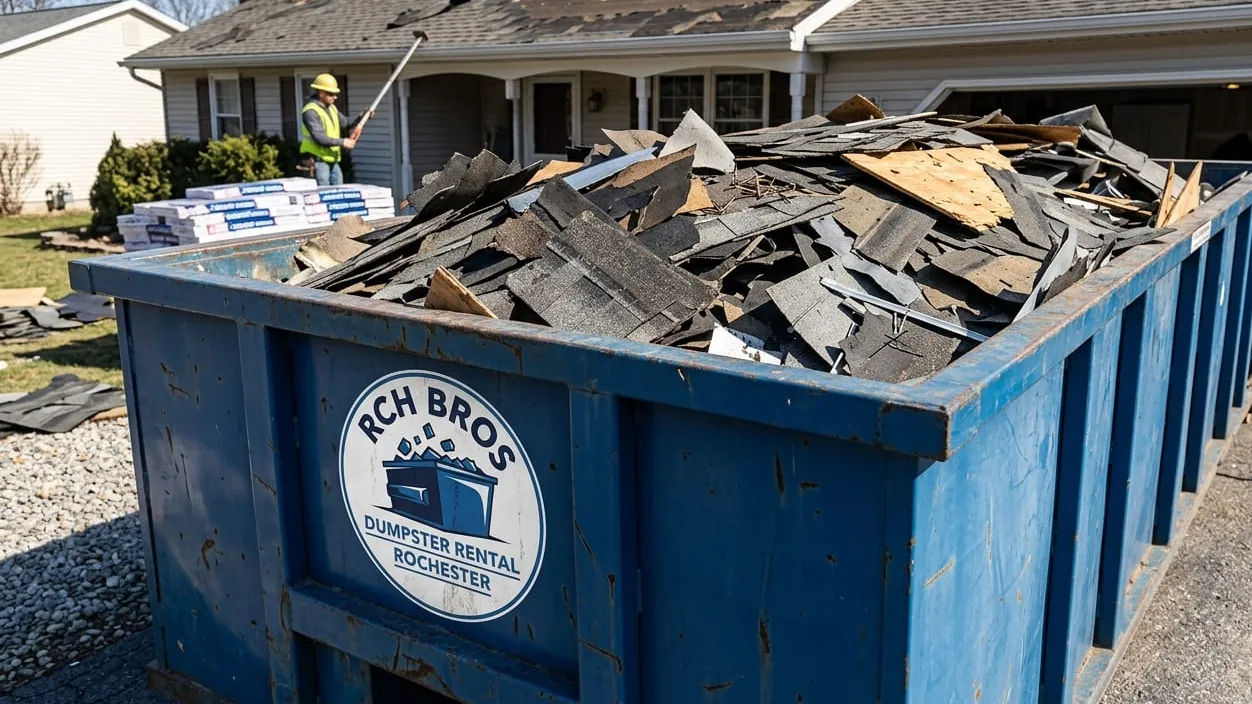
A roofing container is the easiest one to size and the easiest one to get wrong. Easy to size because a roof is a known quantity before you start: you can count it off the ground with a tape and a little arithmetic. Easy to get wrong because shingles are all weight and almost no volume, so the box looks empty right up until the truck cannot legally take it.
Here is how we size a tear-off in Rochester, what the old stock around here adds to the job, and why the five-foot fire clearance matters more on a roof job than on any other kind.
Squares and layers, not cubic yards
Roofers measure in squares. One square is 100 square feet of roof surface. A modest Rochester two-story with a simple gable might be 16 to 20 squares. A larger suburban house in Penfield or Pittsford with hips, dormers and a garage wing runs 30 or more.
To size a container you need two numbers and one judgment call:
- Squares. Roof area, not house footprint. A steep roof has considerably more surface than the floor plan under it.
- Layers. How many roofs are stacked up there. Two layers is twice the debris of one. Three is three times.
- Shingle type. Architectural and dimensional shingles are noticeably heavier than old three-tab. Anything with a laminated build weighs more per square.
Then there is the wildcard: what is under the shingles. If the deck is coming off too, or you find rotten sheathing, or the roof has skip sheathing under wood shingles from an earlier era, the volume goes up sharply while the weight does not. That is a different sizing problem and it is worth a phone call.
How to count layers before you order
Look at a rake edge or lift a shingle at the eave with a flat bar. Count the courses of material down to the deck. On the older housing in this city it is common to find two layers, and not unusual to find three where somebody roofed over in the seventies and again in the nineties.
You can also read it from the ground. A roof with two or three layers usually shows a thick, stepped edge at the rake and a heavy shadow line at the eave.
Sizing a Rochester tear-off
These are our working numbers. They assume asphalt shingles going into the box with underlayment, ridge and normal nail-out, and no deck.
| Roof size | One layer | Two layers | Three layers |
|---|---|---|---|
| Up to 15 squares | 10 yard | 15 yard | 20 yard |
| 16 to 25 squares | 15 yard | 20 yard | 20 yard plus a swap |
| 26 to 35 squares | 20 yard | 20 yard plus a swap | Two 20 yard loads |
| 36 squares and up | 20 yard, possibly two | Two 20 yard loads | Call us and we will stage it |
You will notice the 30 and the 40 do not appear on that table. That is deliberate. Those are volume boxes for light, bulky debris, and shingles are the opposite of that. A 40 yard container full of a three-layer tear-off is a load nobody can legally move. On roofing, we size by weight and swap when we need more capacity. It is the cheaper answer and it is the only one that gets down the road.
When to size up instead
Three cases push you up a size rather than toward a swap.
- The deck is coming off. Plywood or board sheathing is bulky and comparatively light. It fills a box fast.
- Wood shingles under the asphalt. Cedar over skip sheathing takes far more room per square than it weighs.
- The job includes soffit, fascia, gutters or a porch roof. All bulk, little weight.
Our general size guide covers the same bulky-versus-dense logic across every other kind of job.
The five-foot rule bites hardest on a roof job
New York’s fire code, the Fire Code of New York State at 19 NYCRR Part 1225, carries the International Fire Code rule that a container over the size threshold may not be placed inside a building or within five feet of combustible walls, openings or combustible roof eave lines. The threshold itself tightened in the 2025 code cycle, so check with your local code enforcement officer. We place every container at least five feet off the siding, the soffit line and any door or window.
Read that phrase again: combustible roof eave lines. On a roofing job, the natural instinct is to tuck the container as tight to the house as possible so the crew has a short throw off the edge. That is precisely the placement the rule is about. Five feet off the eave line is not negotiable, and on a narrow city lot in the South Wedge or Maplewood it can be the difference between a driveway placement and a street placement.
Plan for it. Measure the drive before you book, tell us where the crew wants to work, and we will find the spot that satisfies both. The New York Department of State publishes the Uniform Code the fire code sits inside.
Placement, plywood and the drop zone
Roofing debris does not land gently. A tear-off puts a concentrated impact load into whatever the container is sitting on, over and over, for a day.
We lay plywood under every wheel and under the rails on every driveway placement. A loaded 20 yard container puts several tons on a small footprint, and in March and April, when frost is coming out of the ground here, asphalt driveways over Monroe County’s silt loams are at their softest. On a roofing job the load arrives fast, which makes the plywood more important, not less.
A few other placement habits worth having:
- Tarp the ground on the throw side. Nails come off a roof by the thousand.
- Keep the load below the rails. A shingle load above the rail cannot be tarped or legally hauled.
- Load front to back, flat. Shingles stack better than they pile, and a flat load rides better.
- Sweep and magnet the drive before we pick up, not after.
- Watch overhead. Service drops and mature street trees decide a lot of placements on city lots.
If the container has to go in the street, that is a written right-of-way permit from the City Engineer under City Code § 104-24, and § 104-24(C) requires the obstruction to be barricaded and lit at night.
Ice dams, and what they add to the job
In Rochester, roof water damage is an ice dam story. Snow accumulates, heat escapes through the roof deck, meltwater runs down and refreezes at the cold eave, and the dam that forms backs water up under the shingles.
By the time you are tearing off, that history is often visible: soft sheathing along the eave, stained or rotted fascia, saturated insulation in the eave bays, and sometimes a strip of decking that has to come out to the second or third rafter. Every bit of that is debris nobody counted when the estimate was written.
Three practical consequences:
- Wet material is heavy material. Soaked sheathing and saturated insulation weigh far more than the dry version.
- Deck repair changes the volume. A few sheets is nothing; a full eave course around the house is a size class.
- Leave headroom. On any tear-off of a house that has had ice dam trouble, we plan the container with room for surprises rather than filling it to the line.
What an old Rochester roof tends to hide
More than half of the city’s housing units were built before 1940, and roughly nine houses in ten predate 1980. That has consequences on a roof, and they are consistent enough to plan around.
Framing and decking
The oldest stock is balloon framed with true-dimension rafters and board sheathing rather than plywood. Board decking tears off in long pieces, it is bulkier per square foot than sheet goods, and if any of it is coming out you should expect it to eat volume faster than the shingles did. Skip sheathing under an original wood-shingle layer is the extreme version of the same thing.
Ventilation and the reason ice dams happen here
Older Rochester houses were not built with the ridge and soffit ventilation that modern assemblies rely on, and many have had insulation added to the attic floor over the decades without any change to the airflow above it. That combination, plus a hundred inches of snow sitting on the deck, is the recipe for the ice dam damage you find at tear-off. If the roof is coming off anyway, it is the cheapest moment in the building’s life to fix the ventilation.
City roofs and suburban roofs are different jobs
Inside the city line, roofs are usually smaller and steeper, lots are narrow, the driveway is single-width, and there is often a mature street tree over the placement. Out in Greece, Webster, Penfield, Pittsford and Perinton, the roofs are bigger and simpler, the driveways are wide, and placement is rarely the constraint. Same shingles, entirely different logistics day. Tell us which one you have and the delivery plan writes itself.
Winter tear-offs in a 102-inch snow market
Rochester’s 1991 to 2020 normal snowfall is 102.0 inches, published by the National Weather Service. January alone averages 27.4 inches over 17.6 snow days. Across the county the totals vary enormously, from roughly 70 inches south of the city to about 90 in the city itself and over 120 along the lakeshore east of it.
Winter tear-offs happen here anyway, because roofs fail when they fail. Two rules make them work.
First, tarp or lid the container. Snow in an open box is weight your customer pays to haul, and a shingle load already carries very little spare payload. A container left open in a Rochester driveway in January is getting snowed on roughly every other day.
Second, size the day, not just the roof. Tear off only what you can dry in and load in the working window you actually have. Half a roof open with a lake-effect band setting up is a bad afternoon. We keep swap schedules tight in winter for exactly this reason, and it is worth calling early in the day. There is more on cold-weather logistics in our winter dumpster rental article.
What else comes off the roof
Most of the surrounding material rides in the same container as the shingles: underlayment, drip edge, ridge vent, pipe boots, gutters, aluminum fascia wrap, plywood and board sheathing, and dry insulation.
A few things do not.
- Chimney masonry. If a chimney is coming down as part of the job, that brick belongs in a 10 yard by itself. Mixed into a shingle load it will put the box over.
- Asbestos. Older cement roofing and some flashing compounds can be suspect on pre-1974 buildings. We do not accept asbestos. It moves under a separate NYSDEC Part 364 permit and must be handled by a NYSDOL-licensed asbestos contractor under 12 NYCRR Part 56.
- Solar panels and attic electronics. Electronics have been banned from landfills, trash and curbside since 1 January 2015.
- Old fuel or tar kettles and solvents. Household hazardous waste goes to the Monroe County ecopark, by appointment.
Book it with the numbers in hand
Call with three things and we will have the right box on the driveway: the square count, the layer count, and whether the deck is coming off. Tell us the address too, since a narrow city lot with a mature street tree is a different placement conversation from a suburban drive in Webster or Greece.
We run roofing containers across the city and the county, and we schedule them around the crew rather than the other way around. See the roofing dumpster service page for how we handle swaps on multi-day jobs, or just call (585) 514-5622.
Questions this guide did not answer? Call (585) 514-5622. We would rather spend two minutes on the phone than have you order the wrong container.