
The Rochester default
20 Yard Dumpster Rental in Rochester, NY
The most ordered container in this county, and usually for good reason. A full basement and attic clear-out is the Rochester default job, and this is the container that matches it. It has the volume to absorb work that grows as you look at it, and the payload to take a fair proportion of dense material without becoming a container that cannot legally move. The trade is footprint: at twenty-two feet it needs more driveway than a 15 does.
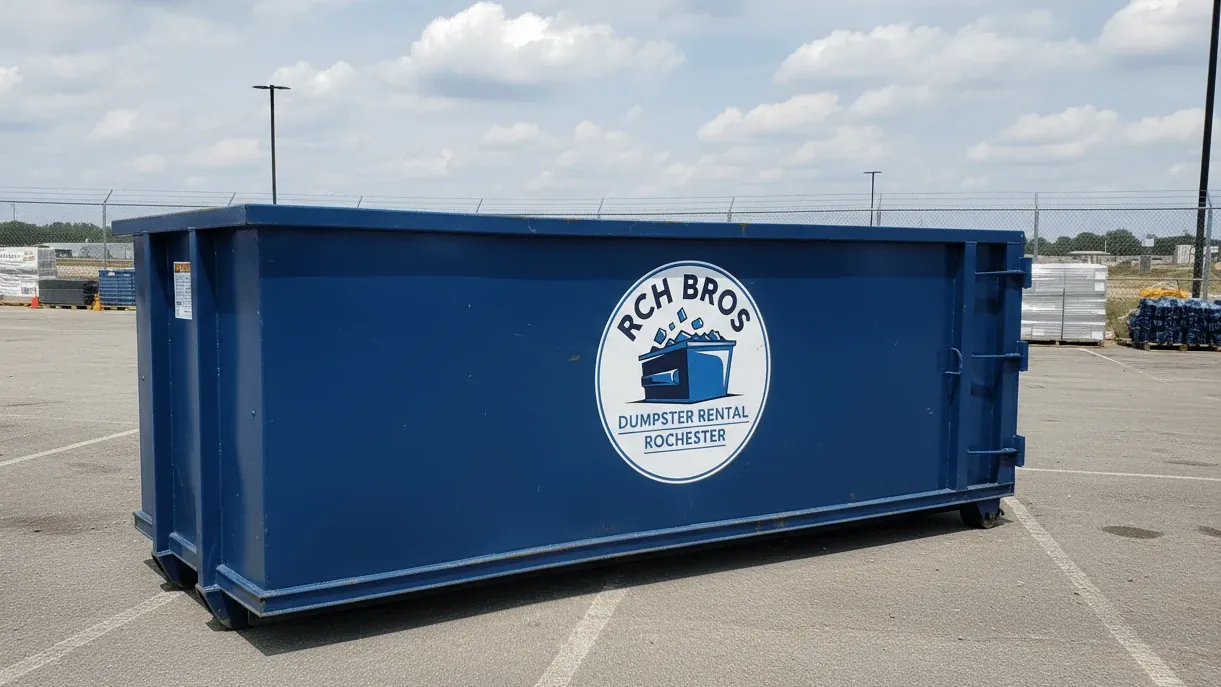
A 20 yard roll-off is about twenty-two feet long, eight feet wide and roughly four and a half feet tall — six to eight pickup loads. It is the size most Rochester jobs land on, because it holds a whole house’s worth of stored material without the height that makes a taller container easy to overload. The footprint is the thing to check before you book: twenty-two feet plus room for the truck is more driveway than a narrow city lot always offers.
- Capacity20 cubic yards
- Footprint22 ft x 8 ft x 4.5 ft
- Weight allowance3 – 4 tons
- Holds about~6 – 8 pickup truck loads
Why people choose the 20 yard
The 20 is the default here because it matches the most common job in the city. More than half of Rochester’s housing units were built in 1939 or earlier, and houses of that age were built with full excavated basements and floored attics as a matter of course. So the standard residential job in this market is not a garage tidy-up, it is two full storage levels emptied over two or three weekends: shelving, boxed paper, canning jars, storm windows, furniture stored on end, a workbench built in place, trunks, bed frames and forty years of things that went down the stairs and never came back up. Household contents fill volume a good deal faster than they build weight, which is exactly what a 20 is good at. It will take a genuinely large clear-out and still leave enough driveway to get a car past. It is also the size most estate cleanouts of a smaller Rochester house end up needing, and the one we suggest most often when somebody describes a basement and an attic in the same phone call.
It also has the most forgiving weight behavior of any size we run. A 10 will reach payload on rubble alone. A 30 or a 40 is tall enough that you can put four tons in it while it still looks half empty. A 20 is short enough to see into and big enough to hold a real job, which means a normally mixed load reaches the fill line and the payload at roughly the same time. That is a genuinely useful property on a Rochester clear-out, where the material is a mix of light bulky household goods and heavy old-house material: plaster off a pre-1940 wall, tile in a mortar bed, a cast-iron radiator or two, and whatever the basement took in the last wet spring. Load the heavy material flat on the floor of the container and the bulky material on top of it, and the whole thing behaves. That balance is why we recommend this size more often than any other, and why we still ask what the material is before confirming it.
The 20 is also the sensible roofing container for a substantial house, and roofing sizing here is arithmetic. Count squares of a hundred square feet, count layers. A single layer of three-tab runs in the region of two hundred and fifty pounds a square and architectural shingle is heavier, and a second layer roughly doubles the weight without doubling the volume. A 20 covers a larger Rochester house at one layer, a mid-size roof at two, or a job where decking is coming off alongside the shingle. Ice-dam damage is what usually adds the decking. This county averages 102 inches of snow a year, meltwater runs down to the cold overhang and refreezes at the eave, and water backs up under the shingle courses until the plywood at the bottom of the roof plane goes soft. Plywood is bulky where shingle is dense, so a tear-off that turns into a partial decking job needs volume rather than payload. Say at booking whether decking is coming off and we will size it properly.
Where a 20 goes wrong is the driveway rather than the load. Twenty-two feet of container plus the truck to place it needs about 60 feet of straight approach, roughly ten and a half feet of working width and 20 feet or more of overhead. That is available on plenty of Monroe County properties and unavailable on plenty of others, particularly on the narrow city lots where free-standing houses sit close together and the drive is a single car wide with a porch overhanging one edge. If the driveway will not take it, the choice is a 15 with a planned swap, a lawn-edge set in dry weather, or a street placement under a right-of-way permit from the City Engineer. All three are workable. What does not work is a driver arriving to find sixteen feet of usable ground and a twenty-two foot container on the truck. Measure the usable ground before you ring, or send a photograph from the curb, and we will tell you honestly whether a 20 will go where you want it.
Good fit for
- A full basement and attic clear-out
- A whole flat turned over between tenants
- Medium remodels and multi-room work
- A substantial roof tear-off
- Estate clearance of a smaller house
- Garage demolition and porch removal
- Large property and garden clearance
- Mixed household and renovation debris
Not the right size for
- Pure concrete, brick or stone rubble
- Rubble foundation spoil and excavated rock
- A basement full of water-damaged contents
- A whole two-family emptied top to bottom
- Commercial gut jobs and office fit-outs
- Any driveway under about twenty-five feet
Will it fit?
The 20 is where placement starts to matter. Twenty-two feet of container plus the truck wants about 60 feet of straight approach, roughly ten and a half feet of working width, and 20 feet or more of overhead clearance so the hoist can stand the container up as it comes off the rails. On Rochester’s older residential streets the overhead is the binding constraint far more often than the ground: the canopy over the tree lawn is mature and the electrical service drop crosses beneath it from the pole to the house. A truck will drive under a wire the hoist cannot work under. Walk to the curb, look up, and send us a photograph if you are unsure. On the ground we lay plywood under every wheel and under the rails, and we photograph the driveway on arrival. That matters most in March and April: the dominant soils in this county are silt loams that hold water, and a loaded 20 puts several tons on four small contact points at exactly the time of year when a thawing asphalt drive is at its softest. On placement we hold five feet clear of combustible walls, openings and combustible roof eave lines, under the Fire Code of New York State at 19 NYCRR Part 1225. The capacity threshold that triggers that rule tightened in the 2025 code cycle, so check the current figure with your local code enforcement officer. A container touching the sidewalk, tree lawn or street needs a written permit from the City Engineer under City Code § 104-24, barricaded and lit at night under § 104-24(C).
Before delivery, move cars and bins, mark irrigation heads and septic lids, and tell us about new concrete, soft ground, a steep grade or low power lines. Our delivery and driveway protection guide covers all of it.
Compare all four sizes
| Size | Footprint | Weight allowance | Holds about | Best for |
|---|---|---|---|---|
| 10 Yard Dumpster | 12 ft x 8 ft x 3.5 ft | 2 – 3 tons | ~3 pickup truck loads | Concrete, brick, plaster and lath and rubble foundation spoil — weight fills it long before volume does. |
| 15 Yard Dumpster | 16 ft x 8 ft x 4 ft | 2 – 3 tons | ~4 – 5 pickup truck loads | A single room, a small tear-off, or one unit of a two-family turnover. |
| 20 Yard Dumpster | 22 ft x 8 ft x 4.5 ft | 3 – 4 tons | ~6 – 8 pickup truck loads | A full basement and attic clear-out — the Rochester default — or a multi-room remodel. |
| 30 Yard Dumpster | 22 ft x 8 ft x 6 ft | 4 – 5 tons | ~9 – 12 pickup truck loads | A whole two-family turnover with basement and attic, or a large remodel. |
| 40 Yard Dumpster | 22 ft x 8 ft x 8 ft | 5 – 6 tons | ~12 – 16 pickup truck loads | Whole-house cleanouts, commercial gut jobs and redevelopment debris. |
Still not sure? Describe what you are throwing away and we will size it on the phone in two minutes. Getting it wrong costs us more than it costs you, so we have every reason to get it right. Call (585) 514-5622.
Book a 20 yard
Flat rate including delivery, pickup, rental period and disposal. Same-day where we can.
(585) 514-5622Other sizes
Popular services
All sizes
Compare our four roll-off containers
10 Yard Dumpster
Concrete, brick, plaster and lath and rubble foundation spoil — weight fills it long before volume does.
View this size → 15yd³15 Yard Dumpster
A single room, a small tear-off, or one unit of a two-family turnover.
View this size → 20yd³20 Yard Dumpster
A full basement and attic clear-out — the Rochester default — or a multi-room remodel.
View this size → 30yd³30 Yard Dumpster
A whole two-family turnover with basement and attic, or a large remodel.
View this size → 40yd³40 Yard Dumpster
Whole-house cleanouts, commercial gut jobs and redevelopment debris.
View this size →20 Yard Dumpster FAQs
Why is the 20 the default in Rochester?
Because the default job here is a full basement and a floored attic emptied together, and that is what a 20 holds. More than half the housing in this city was built before 1940, and houses of that age were built with a full excavated basement and a usable attic as standard. Both have been used as storage by the same families for decades. Household contents fill volume quickly without building much weight, so a 20 takes a genuinely large clear-out and still goes out at a lawful payload. It is also short enough to see into, which stops people burying heavy material at the bottom and losing track of the weight.
Will it fit on my driveway?
Measure before you ring. You want roughly 60 feet of straight approach for the truck, about ten and a half feet of working width, and 20 feet or more of overhead clearance for the hoist. The container itself is around twenty-two feet. Plenty of suburban drives in Greece, Penfield, Webster and Pittsford take it easily. Plenty of city drives do not, because the lots are narrow, the houses sit close together and there is often a porch overhanging one side. If it will not go, the answer is usually a 15 with a planned swap. Send a photograph from the curb looking up the drive and we will tell you straight.
Can I put plaster and masonry in it?
A proportion, yes, and that is one of the things this size does well. What you cannot do is fill it with dense material, because a 20 full of plaster, tile or rubble will reach a legal payload while it still looks half empty and then it cannot lawfully leave your driveway. The working rule is that heavy material goes flat on the floor and light material goes on top, and if the dense material is more than a modest share of the job it belongs in a separate 10 or 15. On a full gut of a pre-1940 room, run two containers and load by material rather than by convenience.
Is it big enough for a roof?
For a substantial Rochester house at a single layer, yes, and for a mid-size roof at two layers. Do the arithmetic rather than the eyeball: count the squares, count the layers, and remember that architectural shingle is heavier than three-tab. What tends to change the answer here is ice damage. With 102 inches of snow a year, meltwater refreezing at the eave backs water under the shingle courses, and after several winters the decking at the bottom of the plane is soft. If plywood is coming off with the shingle you are adding volume rather than weight, so tell us and we will size accordingly.
How long can I keep it?
As long as the job honestly needs, and a basement and attic clear-out usually needs longer than people first think — two or three weekends is normal, because the material comes up a stair one armful at a time. Ring the yard on (585) 514-5622 when you want it collected and we will fit it into the route rather than hold you to a fixed day. Keep it tarped between sessions. Rain turns cardboard and carpet into payload, and in a Rochester January an open container is collecting snow on roughly every other day. If it is in the street, the right-of-way permit sets its own timeframe.
Services
What people put in a 20 yard
Residential Dumpster Rental
Driveway placement for the full-basement, attic and porch cleanouts a pre-1940 house produces.
Learn more →Commercial Dumpster Rental
Containers for businesses and contractors — City Code §20-15F puts construction waste on you, not the City.
Learn more →Construction Dumpster Rental
Mixed C&D in one roll-off, with next-day swap-outs across Monroe County.
Learn more →Roofing Dumpster Rental
Weight-rated cans sized by squares and layers, set five feet off the eave line.
Learn more →Roll-Off Dumpster Rental
10, 15, 20, 30 and 40 yard roll-offs across Rochester and Monroe County.
Learn more →Same-Day Dumpster Rental
Call before the cut-off and we can usually get a container to you this afternoon.
Learn more →Talk to a real person
Need a 20 yard in Rochester?
Tell us what you are clearing out and we will tell you the right size and the flat price to put it in your driveway. No forms, no waiting on an email — just call and we will sort it out in a couple of minutes.
Serving Rochester, Monroe County and Greater Rochester · Mon–Fri 6:30am–5pm, Sat 7am–1pm