
Roofing
Roofing Dumpster Rental in Rochester
Tear-offs sized by squares and layers, not by guesswork. Shingle is a weight load, ice dams drive half the work in this county, and the container still has to sit five feet off the eave line.
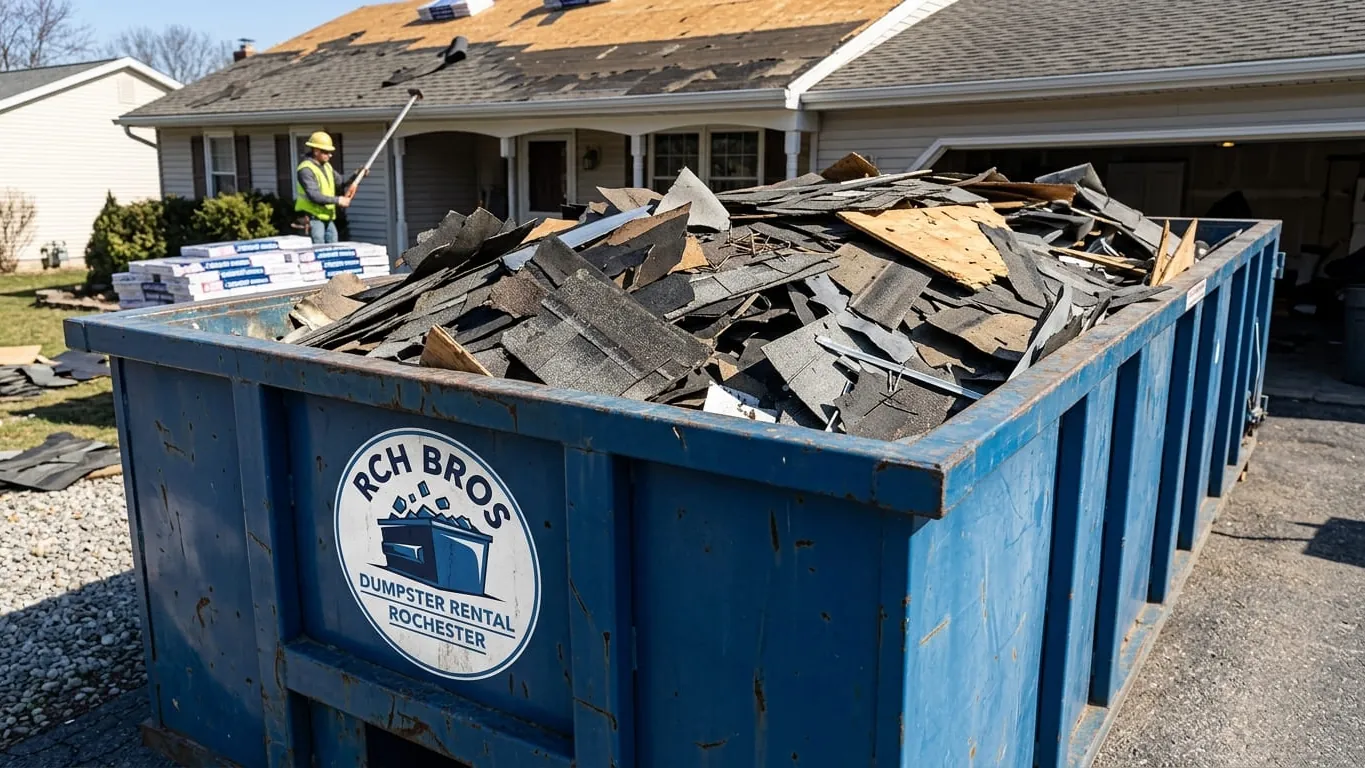
Roofing is the one job on this site where the sizing question has a real arithmetic answer, and it is not about volume. A roof is measured in squares, and a square is a hundred square feet of roof surface. What decides your container is the number of squares and the number of layers coming off, because shingle is dense. A single layer of three-tab runs in the region of two hundred and fifty pounds per square, and architectural shingle is heavier again. Two layers roughly doubles the weight without doubling the volume, which is why a tear-off container reaches its legal payload long before the sides look full. Count the squares, count the layers, and tell us both when you call. That one sentence gets the size right more reliably than any description of the house, and it is the whole method behind our tear-off size guide.
What generates roofing work in Monroe County is mostly winter, and specifically ice dams. Rochester averages 102 inches of snow a year. Snow accumulates on a roof, heat escaping through the ceiling plane melts the underside of the pack, the meltwater runs down to the cold overhang and refreezes at the eave, and the ridge of ice that builds there backs water up under the shingle courses. What you see inside is a stain on a bedroom ceiling in February. What you find in April is rotted decking at the eave, saturated insulation in the attic bay, and shingle that has been lifted and refrozen for three winters running. That is why a Rochester tear-off so often turns into a decking job at the bottom four feet of the roof plane, and why we ask at booking whether decking is coming off. Decking changes the container. Plywood and board sheathing are bulky where shingle is dense.
The other seasonal fact is timing. Roofing here is compressed into the months when the deck is dry and the shingle will seal, and that puts real pressure on scheduling in spring and autumn. Winter tear-offs do happen, usually because something has failed rather than because somebody planned it, and they are a different job: shorter working days, snow to clear off the deck before you can strip anything, and a container that is collecting snow while it sits. Snow in an open container is weight you pay to haul, so a winter tear-off gets tarped between sessions and collected promptly rather than left standing. If your job is weather-dependent, say so when you book and we will keep the slot flexible rather than pretending a fixed date exists. Our winter rental article goes through how we route in January and February.
Placement on a roofing job is different from every other service we run, because you want the container as close to the roof edge as it can legally go and the code says exactly how close that is. The Fire Code of New York State, at 19 NYCRR Part 1225, carries the International Fire Code rule that a container over the size threshold shall not be stored in buildings or placed within five feet of combustible walls, openings or combustible roof eave lines. Five feet is the stable number across code cycles and it is the one we work to. The capacity threshold itself tightened in the 2025 code cycle, so check the current figure with your local code enforcement officer. On a roofing job that five-foot line is the constraint that picks the spot: close enough that tarps can run from the eave into the box, far enough off the siding and the soffit to be lawful. We set every container with that measured, not eyeballed.
Then there is what comes off with the shingle. Flashing, drip edge, valley metal, vents and any gutter and downspout coming down are scrap metal and are worth separating rather than burying in the load. Old felt and ice-and-water membrane go in with the shingle. If the job includes a chimney rebuild or a masonry repair at the same time, that rubble is dense and belongs in a separate small container loaded flat, not on top of the shingle. And if the house is pre-1978 and the job disturbs painted exterior surfaces — fascia, soffit, trim, rake boards — over 20 square feet, the federal renovation, repair and painting rule applies to the work. In a city where roughly nine houses in ten predate 1980, that is a routine consideration on exterior work, not an unusual one. Call (585) 514-5622 with your squares and layers and we will size it in a minute.
Rochester Roofs And What Comes Off Them
Single-Layer Asphalt Tear-Off
The standard job. Count the squares and assume roughly two hundred and fifty pounds a square for three-tab, more for architectural. Load flat and stop at the fill line rather than the rim.
Two And Three-Layer Strips
Common on older city housing where a layer was added rather than removed. Each additional layer adds weight without adding much volume, and it is the fastest way to overload a container.
Ice-Dam Decking Repairs
The bottom four feet of the roof plane, rotted from years of meltwater backing up at the eave. Wet plywood and board sheathing are bulky and heavy, and they change the size calculation.
Attic Insulation Removal
Saturated batts and blown-in insulation pulled out after an ice-dam leak. Light dry, very heavy wet, and it holds water the whole time the container sits open.
Flat And Low-Slope Roofs
Built-up roofing, modified bitumen and rubber membrane off garages, porch roofs and small commercial buildings. Dense material with gravel or ballast through it.
Flashing, Gutter And Metal
Drip edge, valley metal, step flashing, vents, gutter and downspout. Scrap metal, worth separating rather than burying in the middle of a shingle load.
Chimney And Masonry Repairs
Brick, mortar and flue tile taken down alongside the roof work. Dense rubble that belongs in its own small container loaded flat on the floor.
Storm And Wind Damage
Blown-off courses, lifted ridge cap, a tree limb through the deck. Usually urgent, usually mixed material, and usually a same-day or next-day container.
Sizing A Tear-Off Container By Squares And Layers
Do the arithmetic rather than the eyeball. A 10 yard suits a small roof at a single layer — a garage, a porch roof, a small extension — or a modest roof where two or three layers are coming off and the weight is the binding constraint. A 15 yard handles the majority of mid-size Rochester houses at one layer, or a smaller roof carrying two. A 20 yard covers a larger house, a two-layer strip on a mid-size roof, or a job where decking is coming off alongside the shingle. A 30 yard is for large or complex roofs, multi-building jobs and light commercial, and it is the size to take when volume rather than weight is the limiter, such as a low-slope roof with a lot of insulation board. If you are between two sizes and the layer count is uncertain, take the smaller container and plan a swap rather than finding out at the gate. Sizes and dimensions are on the container sizes page.
10 Yard Dumpster
Concrete, brick, plaster and lath and rubble foundation spoil — weight fills it long before volume does.
View this size →15yd³15 Yard Dumpster
A single room, a small tear-off, or one unit of a two-family turnover.
View this size →20yd³20 Yard Dumpster
A full basement and attic clear-out — the Rochester default — or a multi-room remodel.
View this size →30yd³30 Yard Dumpster
A whole two-family turnover with basement and attic, or a large remodel.
View this size →Setting The Box At The Eave Line
On a tear-off you want the container tight to the work, and the five-foot rule is what defines tight. Under 19 NYCRR Part 1225 a container over the size threshold cannot sit inside a building or within five feet of combustible walls, openings or combustible roof eave lines, and that five-foot figure has been stable across code cycles. We measure it. Around that, the usual Rochester access questions apply: roughly 60 feet of straight approach, about ten and a half feet of width and 20 feet or more of overhead. Overhead is the one that catches people on residential streets here, because the mature canopy over the tree lawn has the electrical service drop running beneath it. On a roofing job that matters twice over, since the same wire is often exactly where the tarps want to run. Plywood goes under the wheels on every driveway set. Rochester driveways carry decades of freeze-thaw already, and a loaded roofing container is a weight job even when it looks half empty. If the container has to sit in the street, that is a written right-of-way permit from the City Engineer under City Code § 104-24, barricaded and lit at night under § 104-24(C).
Not sure this is the right service? Describe the job on the phone and we will point you at the right container even if it is a different service page. Call (585) 514-5622.
Get a flat quote
Two minutes on the phone gets you a size, a price and a delivery slot. No forms.
(585) 514-5622Recommended sizes
How it works
Roofing Dumpster Rental in four steps
- 1
Call us
Tell us the project, your address and when you want it. Two minutes on the phone and you have a flat price.
- 2
We deliver
Our driver walks the drop, lays protection boards and sets the container exactly where you want it.
- 3
You load it
Take your time within your rental window. Keep it level with the top rail and we handle the rest.
- 4
We haul it
Call or text when you are done. We pull it, sort what can be recovered and dispose of the rest properly.
Roofing Dumpster Rental FAQs
What size do I need for a 25-square roof?
At a single layer of three-tab, 25 squares is roughly three tons of shingle before you add felt, flashing and the bits at the ridge, so a 15 yard is usually the honest answer and a 20 gives you room if the layer count turns out to be two. Where it changes is decking. If the bottom courses have rotted from ice dams and plywood is coming off with the shingle, add volume rather than weight and step up a size. Give us the squares, the layers and whether decking is coming off, and we will tell you which container to take. Do not guess high on a shingle load: an oversized container full of shingle hits payload with the sides half empty.
Why do so many Rochester roofs fail at the eave?
Ice dams. This county takes 102 inches of snow a year, and the mechanism is always the same. Snow sits on the roof, heat escaping through the ceiling plane melts it from underneath, the meltwater runs down to the unheated overhang and refreezes there, and the ridge of ice that builds up at the eave backs water under the shingle courses. Three or four winters of that and the decking at the bottom of the plane is soft. It is why so many tear-offs here turn into partial decking jobs, and it is why the honest fix is usually attic air sealing and ventilation rather than just new shingle. Plan the container for both.
Can I do a tear-off in winter here?
It happens, and we deliver for it, but go in with your eyes open. Working days are short, the deck has to be cleared of snow before you can strip anything, and shingle will not seal properly in the cold, so most winter work is a repair or a controlled emergency rather than a planned re-roof. From a container point of view the two rules are tarp it and finish it. Snow falling into an open container is weight you pay to haul, and in January this city averages about 27 inches over roughly eighteen snow days. Call the yard and we will book around the forecast rather than around the calendar.
Does the flashing have to come out of the load?
It does not have to, but it should. Drip edge, valley metal, step flashing, vents, gutter and downspout are scrap metal with real value, and pulling them out of a shingle load takes a few minutes at the end of the day. New York’s recycling framework runs through municipal source separation law under General Municipal Law § 120-aa rather than a statewide ban list, and Rochester adopted its own under City Code Chapter 20, Article IV. Separating metal is good practice either way. What must come out are the things New York bans from the trash outright — electronics, rechargeable batteries, waste tires, mercury thermostats — and, always, anything containing asbestos.
How close to the house can you set the container?
Five feet off the eave line, the siding, the soffit and any door or window. That is the Fire Code of New York State at 19 NYCRR Part 1225 carrying the International Fire Code rule, and five feet is the part of that rule that has stayed constant across code cycles. The capacity threshold that triggers it tightened in the 2025 cycle, so if you want the current figure, ask your local code enforcement officer. Within that constraint we get as close to the work as we can, because the difference between tarps running straight into the container and a wheelbarrow run across the lawn is an hour a day on a crew of three.
More services
Other things we haul
Residential Dumpster Rental
Driveway placement for the full-basement, attic and porch cleanouts a pre-1940 house produces.
Learn more →Commercial Dumpster Rental
Containers for businesses and contractors — City Code §20-15F puts construction waste on you, not the City.
Learn more →Construction Dumpster Rental
Mixed C&D in one roll-off, with next-day swap-outs across Monroe County.
Learn more →Roll-Off Dumpster Rental
10, 15, 20, 30 and 40 yard roll-offs across Rochester and Monroe County.
Learn more →Same-Day Dumpster Rental
Call before the cut-off and we can usually get a container to you this afternoon.
Learn more →Junk Removal Dumpsters
Clear a full basement, attic, porch or garage on your own schedule.
Learn more →Estate Cleanout Dumpsters
Discreet, patient container service for families clearing a lifelong home.
Learn more →Demolition Debris Removal
Containers and fast swaps for porches, decks, sheds, garages and interior gut-outs.
Learn more →Concrete & Heavy Debris
Dedicated heavy cans for concrete, brick, plaster and rubble foundation spoil.
Learn more →Yard Waste & Brush Removal
Separate clean loads — the City picks up leaves, not your deck or your shingles.
Learn more →Where we deliver
Roofing Dumpster Rental across Monroe County and Greater Rochester
Same service, same flat rates, every town below. Pick yours for local placement and permit notes.
Talk to a real person
Need roofing dumpster rental in Rochester?
Tell us what you are clearing out and we will tell you the right size and the flat price to put it in your driveway. No forms, no waiting on an email — just call and we will sort it out in a couple of minutes.
Serving Rochester, Monroe County and Greater Rochester · Mon–Fri 6:30am–5pm, Sat 7am–1pm