
Sizes
What Size Dumpster You Need for a Rochester House
Rochester housing is old, heavy and full-basement. Here is how we size a container from the address and the material, and why dense debris means a smaller box.
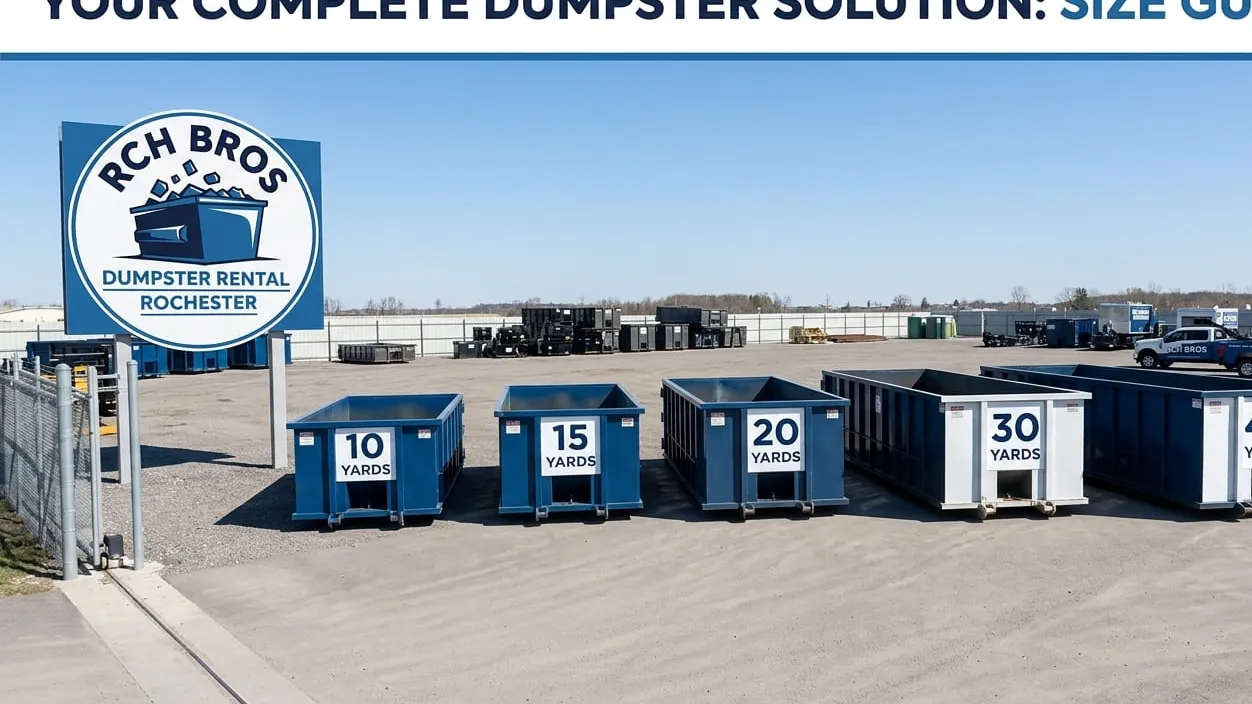
Most people call and ask for a size before they say what is in the pile. Start the other way around. Tell us the house and tell us the material, and the size mostly answers itself.
Rochester makes that easier than a lot of cities, because the housing stock is consistent. More than half of the city’s housing units were built before 1940, and roughly nine houses in ten predate 1980. Full basements are near-universal here. Plaster and wood lath instead of drywall. Stone and rubble foundations in the oldest stock. Knob-and-tube in the attic and cast iron in the stack. Once you know that, you can size a container off an address and a two-minute conversation.
Here is how we do it, and where people get it wrong.
The five containers and what each one is actually for
We run 10, 15, 20, 30 and 40 yard roll-offs. The yardage is volume. It tells you how much air the box holds, not how much material it can legally carry down Lyell Avenue. Both numbers matter, and on a Rochester job the weight limit is usually the one that ends the conversation.
| Container | What it is built for | Typical Rochester job |
|---|---|---|
| 10 yard | Dense, heavy material in a low box you can walk debris into | Concrete, brick, plaster and lath, rubble foundation spoil, dirt |
| 15 yard | One room, or one side of a two-family | Kitchen gut, small tear-off, single-unit turnover |
| 20 yard | The default. Bulky household debris with real weight in it | Full basement and attic clear-out |
| 30 yard | Whole-building volume with mixed material | Two-family turnover, basement to attic, or a large remodel |
| 40 yard | Light and bulky at scale | Whole-house cleanout, commercial gut, redevelopment debris |
The 10 is a weight can, not a small can
People order the 10 because the job looks small. That is the wrong reason. Order the 10 because the material is heavy. Concrete, brick, block, dirt, roofing, and above all plaster with the lath still on it will hit the payload limit long before the box looks full. A 10 yard container that is two-thirds full of plaster is a legal load. The same plaster in a 30 is a truck that cannot leave your driveway.
If you are taking a chimney down, pulling a stone stoop, or breaking up a section of a basement floor, the 10 is the right box and it will look strangely empty when we pick it up. That is the job working correctly.
The 15 covers one room or one unit
A 15 is the right size for a single kitchen, a single bath, a small garage, or one unit of a two-family where you are pulling carpet, cabinets, a vanity and the contents of a closet. It is also a sensible small tear-off can, one layer on a modest ranch, though see the roofing notes below before you commit.
The 20 is the Rochester default
If someone will not tell us anything except the address, we bring a 20. In a city where the basement is full, the attic is floored, and the family has been in the house since the sixties, a full basement and attic clear-out is the single most common residential job we run. The 20 holds it. It sits low enough to walk a wheelbarrow up a ramp into, and it still has enough payload headroom to absorb the mystery weight that always comes out of an old Rochester basement: paint cans that turned out to be full, a cast-iron laundry tub, four decades of magazines, a boiler section nobody could lift.
The 20 is also the size we quote most often for interior demolition in a pre-1940 house, because you almost never get through that job without plaster.
The 30 and the 40
A 30 is a whole two-family turnover with the basement and attic included, or a serious remodel where you are opening walls, replacing windows and taking out flooring in the same month. It is bulky-material volume with enough payload to be useful.
The 40 is for light and voluminous debris at scale: a whole-house cleanout with furniture, a commercial interior strip-out, siding, insulation, shelving, fixtures. Do not put masonry in a 40. Do not put plaster in a 40. It is a volume box, and it will get you a load you cannot legally move.
You can see the full range and the dimensions on our container sizes page.
Plaster and lath is why people guess wrong
This is the single most common reason a Rochester container goes over payload while it still looks half full.
Plaster is sand, lime and horsehair troweled in three coats over sawn wood lath nailed to the studs. It is dense. It absorbs water and gets denser. When you pull a wall in a pre-1940 house on the west side, you are not moving drywall sheets, you are moving something closer to broken masonry with wood in it. A single 12 by 12 room, walls and ceiling both, produces a pile that surprises everyone the first time.
Two things follow. First, when a job includes plaster, we size down and swap more often rather than sizing up. Second, tell us on the phone. “Taking down two walls” and “taking down two plaster walls” are different jobs with different containers. The material drives the box.
The other dense materials in an old Rochester house
- Rubble foundation spoil. Fieldstone and mortar from a repointing or a partial rebuild. Very heavy, no air in the pile.
- Cast iron. Old DWV stack, radiators, a laundry tub, a boiler. A single radiator can run several hundred pounds.
- Wet material. Basement carpet, saturated cardboard, insulation that took on water from an ice dam. Water is the heaviest thing you will load.
- Roofing. Asphalt shingles are one of the densest things a homeowner ever throws away. See our roofing tear-off size guide before ordering.
- Dirt, sod and stone. Landscape spoil belongs in a 10, alone, with nothing else in it.
Weight against volume, in plain terms
Every container leaves here with two limits: how much it holds, and how much the truck can legally carry over the road. When those two limits disagree, the road wins. That is not a policy we invented; it is axle weight and it is enforced.
So the practical rule is simple. If the pile is bulky, size up. If the pile is dense, size down. Bulky means furniture, cabinets, insulation, siding, brush, boxes, mattresses and general household clear-out. Dense means anything that came off a wall built before 1940, anything with mortar on it, anything wet, and anything that used to be a roof.
Mixing the two is fine and it is what most jobs look like. Just tell us the ratio. A basement cleanout with one plaster wall in it is still a 20. A basement cleanout that is mostly the plaster is a 10 and a swap.
We go into what actually moves the number on your invoice in our article on what drives dumpster cost in Rochester.
Where the container sits limits the size you can take
Size is not only a debris question. It is a geometry question, and Rochester lots are narrow.
A roll-off is delivered by tilting the bed and rolling the box off the back. The truck needs a straight approach, overhead clearance, and room to lift. A 40 yard box is long. On a city lot in the South Wedge or Corn Hill with a single-width driveway, a mature street tree and a garage at the back, a 40 does not fit even when the debris would justify it. Two 20s across two weeks will.
Driveway placement is the default and we protect it. A loaded 20 yard container puts several tons on a small footprint, and in March and April, when frost is coming out of the ground here, asphalt driveways over Monroe County’s silt loams are at their softest. We lay plywood under every wheel and under the rails on every driveway placement. That plywood is not a courtesy, it is standard practice on every driveway placement we make.
Street placement is a different animal. A container placed entirely on your own driveway or private property is generally outside the City’s right-of-way permit requirement under City Code § 104-24. If any part of the container or its placement touches the sidewalk, the tree lawn or the street, you need a written permit from the City Engineer. And § 104-24(C) requires the obstruction to be barricaded and lit after dark.
Fire clearance also applies. New York’s fire code, the Fire Code of New York State at 19 NYCRR Part 1225, carries the International Fire Code rule that a container over the size threshold may not be placed inside a building or within five feet of combustible walls, openings or combustible roof eave lines. The threshold itself tightened in the 2025 code cycle, so check with your local code enforcement officer. We place every container at least five feet off the siding, the soffit line and any door or window. On a tight city lot that five feet is sometimes the reason a 30 becomes a 20.
Sizing by the job
These are the calls we make every week, in the order we hear them.
- Full basement and attic, one family, lived in for decades. 20 yard. This is the default job and the default box.
- One unit of a two-family, tenant turnover, carpet and contents. 15 yard, unless there is a basement share, then 20.
- Whole two-family turnover, both units plus basement and attic. 30 yard. Both units plus the shared basement is a 30 yard job.
- Kitchen gut in a pre-1940 house, plaster walls coming down. 15 yard with a swap, or a 20 if the cabinets are staying whole.
- Bathroom, one room, cast-iron tub included. 10 yard. The tub is the reason.
- Chimney removal, stoop, patio slab, walkway. 10 yard, masonry only, nothing else in the box.
- Garage tear-down, single detached. 20 yard if the slab stays, a separate 10 for the slab if it goes.
- Estate cleanout, furnished house. 30 or 40 depending on whether the basement is included.
- Deck removal, average back deck with railings. 15 yard, and keep the footings out unless you ordered a 10 for them.
- Brush, hedge and yard clear-out. 20 yard, kept clean, no soil mixed in.
If your job is not on that list, it is on the phone. Call (585) 514-5622 and describe the pile.
Winter changes the size math
Rochester’s 1991 to 2020 normal snowfall is 102.0 inches, published by the National Weather Service office that covers us. January alone averages 27.4 inches over 17.6 snow days. That means a container sitting open in your driveway in January is getting snowed on roughly every other day.
Snow in an open container is weight. It is weight you did not generate and did not want, and it counts against the same payload limit your debris counts against. So in winter we do three things: we size a little smaller on heavy material, we tarp or lid the box, and we push customers toward shorter rental windows and quicker swaps. It is cheaper to move two loads than to fight one frozen one. Our full write-up is at winter dumpster rental in Rochester.
What does not go in, whatever the size
Some material is not a sizing question at all. It simply does not ride in our container.
- Asbestos. We do not accept it. Asbestos in New York moves under a separate NYSDEC Part 364 permit and must be handled by a NYSDOL-licensed asbestos contractor under 12 NYCRR Part 56.
- Electronics. Banned from landfills, trash and curbside since 1 January 2015 under ECL Article 27, Title 26. The Monroe County ecopark at 10 Avion Drive takes them with no appointment.
- Rechargeable batteries. Illegal in the trash under Title 18, and a 2025 amendment brought e-bike and e-scooter packs in with them.
- Tires. Land burial of waste tires is prohibited under Title 19.
- Household hazardous waste, paint, fuel, solvents. The ecopark takes household hazardous waste by appointment only. It is Monroe County residents only.
- Mercury thermostats. Banned from disposal since 2005, and NYSDEC puts the duty on contractors demolishing buildings specifically.
New York does not have a single waste ban list. It has General Municipal Law § 120-aa, which ordered every municipality to adopt its own source-separation law by 1 September 1992, plus a handful of product-specific bans each sitting in its own Title of the Environmental Conservation Law. That structure is worth understanding before you load anything unusual.
Call it in before you order
The five-minute version: bulky goes up a size, dense goes down a size, plaster goes down two, and if you are not sure, describe the room out loud and we will pick. We run the city and the county, from Charlotte down to Henrietta and out to Chili and Ogden.
Ray and his brother started RCH Bros out of the west side in 2011. We have loaded enough Rochester basements to know what comes out of them. Call (585) 514-5622 and we will size it with you before a truck leaves the yard.
Questions this guide did not answer? Call (585) 514-5622. We would rather spend two minutes on the phone than have you order the wrong container.