
The weight box
10 Yard Dumpster Rental in Rochester, NY
The smallest container we run and the right one whenever the material is dense. Concrete off a driveway, brick off a chimney, plaster and lath out of a pre-1940 wall, rubble foundation spoil, or the contents of a basement that took water. It sits low, goes on a narrow city driveway where nothing longer will swing, and reaches a legal payload long before it looks full. That is the container working correctly, not the container being too small.
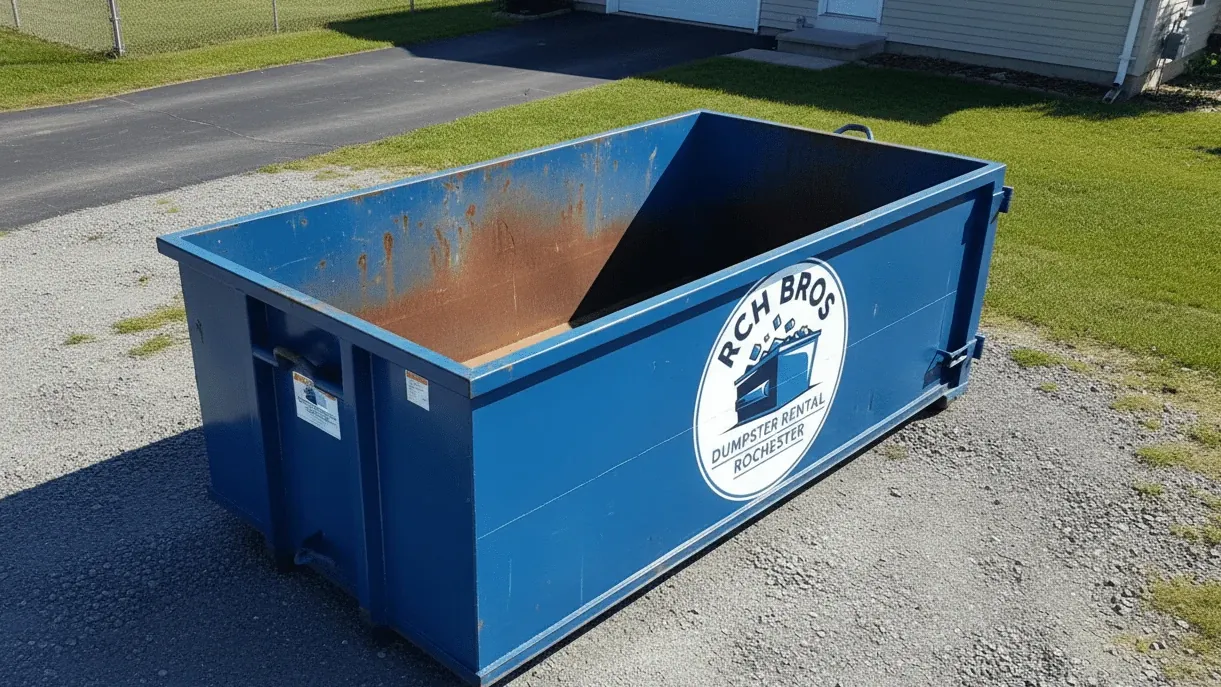
A 10 yard roll-off is roughly twelve feet long, eight feet wide and about three and a half feet tall — three or four pickup loads. The short sides mean material goes in over the rim rather than up a ladder, and the short footprint means it fits on a narrow Rochester driveway where a twenty-two foot container has nowhere to swing. It is the container for heavy, dense material, and the rule that goes with it is simple: load flat, load low, and stop at the fill line rather than the rim.
- Capacity10 cubic yards
- Footprint12 ft x 8 ft x 3.5 ft
- Weight allowance2 – 3 tons
- Holds about~3 pickup truck loads
Why people choose the 10 yard
Start with the material, because in Rochester it decides everything else. Masonry rubble is the classic 10 yard load: broken concrete off a driveway or an apron, brick off a chimney or a porch pier, mortar, block, a section of basement floor, stone from a wall. All of it is several times denser than the mixed household debris people picture when they imagine a roll-off, and a container reaches its legal payload while the sides are still visible. That is why a 10 loaded flat with rubble is the correct tool, and why a 30 loaded with the same material is a container that cannot lawfully leave your driveway. The oldest housing stock in this city sits on stone and rubble foundations rather than poured concrete, so a foundation repair here produces field stone, brick and mortar in irregular lumps mixed with spoil, which is heavier and more awkward than a clean poured wall. Soil is its own conversation. If you are excavating as well as breaking out, tell us at the booking roughly how much is spoil and how much is masonry, because the two are not simply different kinds of rubble and mixing them limits where the load can go.
The second material that belongs in a 10 is the one nobody expects: plaster. More than half of Rochester’s housing units were built in 1939 or earlier, and roughly nine houses in ten predate 1980. Houses of that vintage were plastered over wood lath rather than boarded out, and keyed plaster with the lath still attached is dense, dusty and much heavier than modern board. It is the single most common reason an interior strip-out in this city ends up over payload in a container that still looks half empty. The same applies to bathroom and kitchen tile from older houses, which comes off with the mortar bed attached and behaves like masonry rather than like tile. If you are taking one room of a pre-1940 house back to the studs, the honest answer is usually a 10 for the plaster and the tile and a second, larger container for the cabinetry, the timber and the general debris. Two containers loaded by material beat one container loaded by whichever pile is nearest the door, every single time, and it is consistently the cheaper arrangement rather than the more expensive one.
The third case is water, and in Rochester that means basements rather than rivers. The Genesee was tamed upstream: the Army Corps built the Mount Morris Dam at the northern end of Letchworth between 1948 and 1952, and the Corps credits it with preventing $4.5 billion in flood damage, including $210 million during Hurricane Agnes in 1972 alone. Downtown does not flood. Basements do. A failed sump, a burst supply line, a spring where the ground is saturated, or meltwater backing down an interior wall behind an ice dam — all of them produce the same load. Sodden carpet, saturated cardboard, swollen furniture and wet insulation weigh two to three times what the same material weighs dry, and they keep gaining weight as long as the container stands open in the weather. A 10 yard, loaded flat, tarped between sessions and collected promptly is the right way to move wet basement contents. A large open container full of the same material is a load nobody can lift. Ring the yard as soon as the basement is clear rather than leaving a wet load standing out in a Rochester November.
The last argument for the 10 is where it can go. This is a city of narrow lots with free-standing houses set close together, and driveways to match: a single car wide, running past the side of the house to a garage at the back, often shared with the neighbour and often with a porch overhanging one edge. At around twelve feet long the 10 will sit on ground where a twenty-two foot container simply cannot be swung off the rails. Its low sides also mean two people can lift material in over the edge rather than carrying everything round to the swing door, which on a basement job with a thirty-foot stair run is worth real time. What still has to work is the approach and the overhead: roughly 60 feet of straight run, about ten and a half feet of width and 20 feet or more of vertical clearance for the hoist. On a Rochester street the overhead is a mature canopy with the electrical service drop running beneath it, and a short container gives the hoist more room than a tall one.
Good fit for
- Broken concrete, brick, block and mortar rubble
- Rubble and stone foundation spoil
- Plaster and lath out of a pre-1940 Rochester wall
- Bathroom and kitchen tile set in a mortar bed
- Wet basement contents after a thaw or a burst pipe
- A single chimney or a set of porch piers
- Concrete steps, walks and driveway aprons
- Small strip-outs on a narrow city driveway
Not the right size for
- Whole-house cleanouts full of furniture
- A full basement and attic in one weekend
- Multi-room remodels making airy debris
- Deck, fencing and brush clearance
- A whole two-family unit turnover
- Roof tear-offs above about fifteen squares
Will it fit?
The 10 is the easiest container we place, which is exactly why it suits Rochester. At around twelve feet long it goes on a narrow city driveway where a twenty-two foot box has nowhere to swing, and its low sides mean material goes in over the rim rather than up a ladder. We still want about 60 feet of straight approach for the truck to line up and back, roughly ten and a half feet of working width, and 20 feet or more of overhead clearance for the hoist. Overhead is what fails in this city rather than the ground: the street canopy is mature across most of the older neighborhoods and the electrical service drop runs beneath it from the pole to the house. A short container gives the hoist more room than a tall one, so where a 30 will not go, a 10 usually will. Plywood goes under the wheels and under the rails on every set, and we photograph the approach on arrival, because Monroe County’s dominant driveway soils are silt loams that hold water and a March apron is at its softest of the year. On placement, the Fire Code of New York State at 19 NYCRR Part 1225 carries the International Fire Code rule that a container over the size threshold may not sit in a building or within five feet of combustible walls, openings or combustible roof eave lines; the threshold tightened in the 2025 code cycle, so check the current figure with your local code enforcement officer. A street set needs a written right-of-way permit from the City Engineer under City Code § 104-24, barricaded and lit at night under § 104-24(C).
Before delivery, move cars and bins, mark irrigation heads and septic lids, and tell us about new concrete, soft ground, a steep grade or low power lines. Our delivery and driveway protection guide covers all of it.
Compare all four sizes
| Size | Footprint | Weight allowance | Holds about | Best for |
|---|---|---|---|---|
| 10 Yard Dumpster | 12 ft x 8 ft x 3.5 ft | 2 – 3 tons | ~3 pickup truck loads | Concrete, brick, plaster and lath and rubble foundation spoil — weight fills it long before volume does. |
| 15 Yard Dumpster | 16 ft x 8 ft x 4 ft | 2 – 3 tons | ~4 – 5 pickup truck loads | A single room, a small tear-off, or one unit of a two-family turnover. |
| 20 Yard Dumpster | 22 ft x 8 ft x 4.5 ft | 3 – 4 tons | ~6 – 8 pickup truck loads | A full basement and attic clear-out — the Rochester default — or a multi-room remodel. |
| 30 Yard Dumpster | 22 ft x 8 ft x 6 ft | 4 – 5 tons | ~9 – 12 pickup truck loads | A whole two-family turnover with basement and attic, or a large remodel. |
| 40 Yard Dumpster | 22 ft x 8 ft x 8 ft | 5 – 6 tons | ~12 – 16 pickup truck loads | Whole-house cleanouts, commercial gut jobs and redevelopment debris. |
Still not sure? Describe what you are throwing away and we will size it on the phone in two minutes. Getting it wrong costs us more than it costs you, so we have every reason to get it right. Call (585) 514-5622.
Book a 10 yard
Flat rate including delivery, pickup, rental period and disposal. Same-day where we can.
(585) 514-5622Other sizes
Popular services
All sizes
Compare our four roll-off containers
10 Yard Dumpster
Concrete, brick, plaster and lath and rubble foundation spoil — weight fills it long before volume does.
View this size → 15yd³15 Yard Dumpster
A single room, a small tear-off, or one unit of a two-family turnover.
View this size → 20yd³20 Yard Dumpster
A full basement and attic clear-out — the Rochester default — or a multi-room remodel.
View this size → 30yd³30 Yard Dumpster
A whole two-family turnover with basement and attic, or a large remodel.
View this size → 40yd³40 Yard Dumpster
Whole-house cleanouts, commercial gut jobs and redevelopment debris.
View this size →10 Yard Dumpster FAQs
Why is a small container right for a big pile of concrete?
Because the limit is weight, not volume. Broken concrete, brick, stone and mortar are several times denser than mixed household debris, so a container hits its legal payload long before the sides fill. A 10 yard loaded flat and low goes out at a lawful weight. The same rubble in a 30 gives you a container that cannot legally move, which costs everybody a morning and solves nothing. Load in pieces two people can place rather than pieces one person can drop, spread the material across the whole floor rather than heaping it at the door end, trim any rebar or mesh back below the rim, and stop at the marked fill line.
Will plaster really fill a 10 yard on its own?
Very often, yes. More than half of Rochester’s housing was built before 1940 and was plastered over wood lath, and keyed plaster with the lath attached is dense and heavy in a way modern board is not. One room stripped to the studs can put a 10 close to payload by itself. That is not a reason to order bigger; it is a reason to split the job. Put the plaster and the tile in a 10 loaded flat, and put the cabinetry, framing and general debris in a larger container alongside it. Two containers loaded by material beat one container loaded by room.
Can I put soil or fill in it?
Tell us before you book rather than after. Soil and clean fill are a separate conversation from masonry rubble, and mixing the two limits where a load can go, so we want to know roughly what the split is before the container leaves the yard. If you are digging footings, remember that New York publishes no statewide frost depth: Table R301.2(1) of the Residential Code of New York State leaves the footing depth blank for each municipality to fill in, and the State’s guidance says the local jurisdiction shall provide it. Ask your town’s building department. And call a locate in to UDig NY before you break ground — at least two but not more than 10 working days under 16 NYCRR § 753-3.1.
Does it fit on a narrow driveway?
Usually, and that is its main advantage here. At around twelve feet long the 10 will sit on a single-width Rochester drive where a twenty-two foot container cannot be swung off the rails. What still has to work is the approach and the overhead: roughly 60 feet to line up and back, about ten and a half feet of width, and 20 feet of vertical clearance for the hoist. If the drive is shared with the neighbour, tell them before the truck arrives rather than after. And the fire code still applies: five feet clear of combustible walls, openings and roof eave lines.
How long can I keep it?
As long as the job honestly needs. Ring the yard on (585) 514-5622 when you want it collected and we will fit it into the route rather than hold you to a fixed day. Two things are worth watching on a heavy container. Keep the tarp on, because plaster and rubble absorb water and a rained-on load gains real weight overnight — and this county averages 102 inches of snow a year, so in January an open container is collecting payload every other day. And if the container is in the street rather than on private ground, the right-of-way permit carries its own time limit set by the City Engineer, so a street set is worth finishing promptly.
Services
What people put in a 10 yard
Residential Dumpster Rental
Driveway placement for the full-basement, attic and porch cleanouts a pre-1940 house produces.
Learn more →Commercial Dumpster Rental
Containers for businesses and contractors — City Code §20-15F puts construction waste on you, not the City.
Learn more →Construction Dumpster Rental
Mixed C&D in one roll-off, with next-day swap-outs across Monroe County.
Learn more →Roofing Dumpster Rental
Weight-rated cans sized by squares and layers, set five feet off the eave line.
Learn more →Roll-Off Dumpster Rental
10, 15, 20, 30 and 40 yard roll-offs across Rochester and Monroe County.
Learn more →Same-Day Dumpster Rental
Call before the cut-off and we can usually get a container to you this afternoon.
Learn more →Talk to a real person
Need a 10 yard in Rochester?
Tell us what you are clearing out and we will tell you the right size and the flat price to put it in your driveway. No forms, no waiting on an email — just call and we will sort it out in a couple of minutes.
Serving Rochester, Monroe County and Greater Rochester · Mon–Fri 6:30am–5pm, Sat 7am–1pm