
Concrete & Heavy
Concrete & Heavy Debris in Rochester
Concrete, brick, block, stone and rubble foundation spoil. This is the one service where the container looks half empty when it is finished, and that is the container doing its job correctly.
Heavy debris is the one category where the usual instinct is exactly wrong. People look at a pile of broken concrete, judge it by eye against the size of a container, and order too big. Concrete, brick, block, mortar and stone are several times denser than the mixed debris most people picture when they imagine a roll-off, so a container carrying them reaches its legal payload long before the sides fill. A 10 yard loaded flat with rubble goes out at a lawful weight. The same material in a 30 gives you a container that cannot legally leave your driveway, which costs a morning and solves nothing. The rule on this page is short: with heavy material, size down and load flat. Then keep going until you hit the fill line and stop there. The container sizes page has the dimensions, but the material decides this, not the dimensions.
Rochester produces more heavy debris than a newer city would, because of what is under the houses. This is glacial ground — till and lacustrine silt laid down by the ice and by Glacial Lake Iroquois — and the oldest housing stock here sits on stone and rubble foundations rather than poured concrete. When one of those walls is repaired, underpinned or taken out, what comes out is field stone, brick, mortar and a great deal of spoil, and it is heavy in a way that a poured wall is not, because it comes out in irregular lumps with mortar attached. The dominant soils above it are silt loams, Collamer and Niagara, which hold water. That combination is why basement work here generates both rubble and wet spoil, and why we ask at booking whether the material is dry stone or wet fill. They are two different loads.
Under all of it, in the middle of the city, is rock. Downtown Rochester sits at the crest of the Niagara Escarpment, a roughly two-hundred-foot ridge of Lockport dolostone, and the Genesee River cuts its gorge straight through it. Depth to bedrock varies sharply across Monroe County — shallow near the escarpment and the gorge, much deeper out on the till plains and the drumlins — which means an excavation in one part of the city hits rock and the same excavation two miles away does not. If your job has hit rock, tell us, because broken dolostone is dense even by the standards of this page and it wants a 10 yard loaded flat with nothing else in it. If you are not sure what you are into, describe the color and the way it breaks and we can usually tell you on the phone.
Clean loads are worth more than mixed ones, and on heavy debris the difference is real. Clean concrete, clean brick and clean block are a recyclable stream. The same material with timber, plastic, insulation, roofing felt and rebar mixed through it is not, and it costs more to move. If you can keep the masonry separate from everything else on site, do. That usually means two containers on a demolition or a driveway job: a small one for the concrete, a larger one for everything else. It is more discipline on site and it is consistently cheaper. On soil and clean fill specifically, tell us before you dig rather than after, because soil is a separate conversation from rubble and mixing the two limits where the load can go. Our construction debris guide covers the separations.
The last thing is the ground the container is standing on, which matters more here than on any other job. A 10 yard container full of concrete is several tons on four small contact points. In March and April, when frost is coming out of the ground and the silt loams under this county are at their wettest, an asphalt driveway is at its softest of the year. We lay plywood under every wheel and under the rails on every driveway placement without exception, and on a heavy job we will often ask for a set point on the apron or the street edge rather than mid-drive. Anything that breaks ground gets a locate through UDig NY first, with at least two but not more than 10 working days’ notice under 16 NYCRR § 753-3.1. Details of the ground protection are in driveway protection.
Heavy Material We Take
Driveway And Apron Breakout
Broken concrete off a drive or an apron, usually with reinforcing mesh through it. Load flat, spread across the whole floor, in pieces two people can place rather than one person can drop.
Rubble Foundation Repairs
Field stone, brick and mortar out of a pre-1900 basement wall. Irregular, heavy, and the classic Rochester heavy load. Dry stone and wet spoil are two different bookings.
Concrete Steps And Walks
Front steps, side walks, patio slabs and porch piers. Dense, awkward, and far heavier than they look when they are still in one piece on the ground.
Chimney And Brick
Brick, mortar and flue tile off a chimney taken down to the roof line or all the way out. Pure masonry and a 10 yard job even when the pile looks small.
Plaster And Lath
Not masonry, but it behaves like it. Keyed plaster off a pre-1940 Rochester wall with the lath attached is the commonest reason a container goes over payload while looking half full.
Tile In A Mortar Bed
Older bathroom and kitchen tile comes off with the bed attached and loads like rubble rather than like tile. Worth separating from the cabinetry and the timber.
Block And Retaining Wall
Concrete block, segmental retaining wall units and the base course under them. Uniform, stackable and heavy, which makes it easy to overload a container quickly.
Excavated Rock
Broken dolostone from an excavation near the escarpment or the gorge. Dense even by the standards of this list, and it wants a container on its own.
Why The Small Container Is The Right One
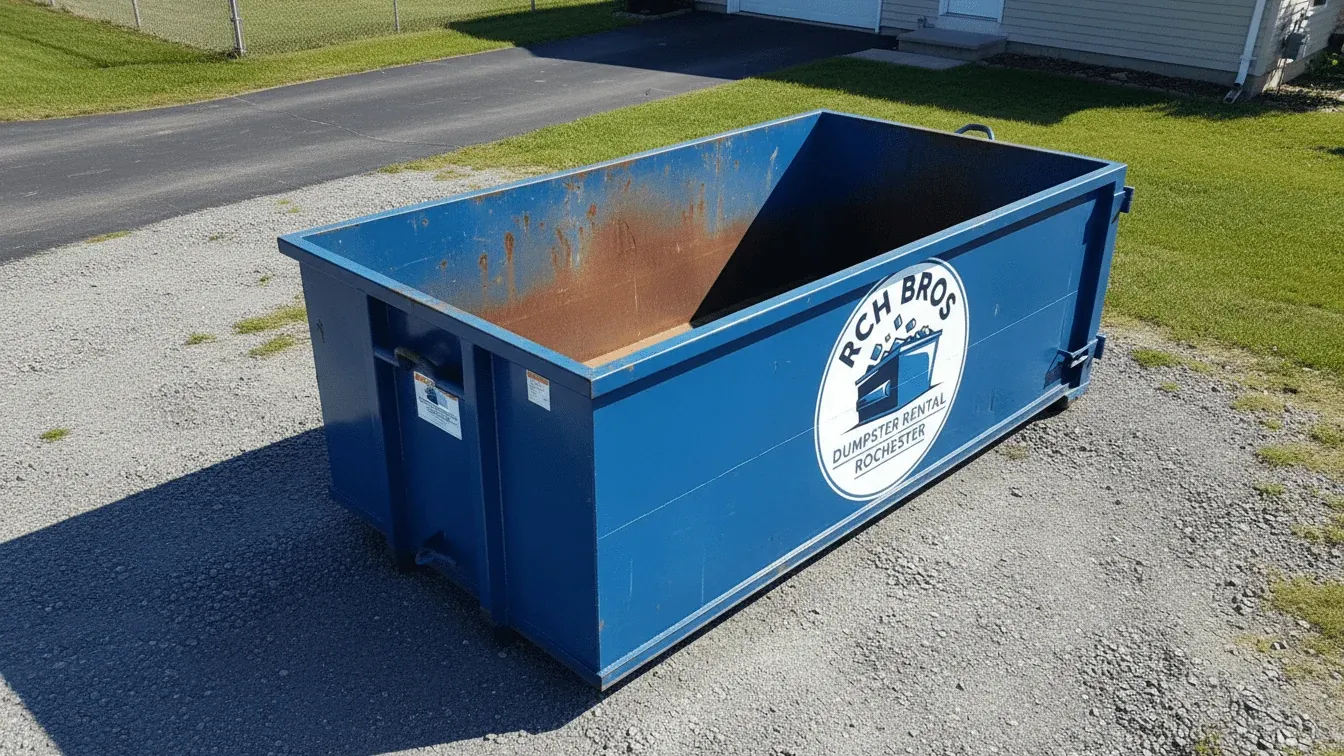
A 10 yard is the default for concrete, brick, block, stone, plaster and rubble foundation spoil, and it will usually finish looking half empty. That is not the container being too small; that is payload. A 15 yard suits a job where the masonry is mixed with a proportion of lighter material — a bathroom strip-out with tile, plaster and cabinetry, for instance, or a small retaining wall with the timber and geotextile that came off with it. A 20 yard is as far up as heavy material ever sensibly goes, and only when the dense portion is a minority of the load. Above that, do not. A 30 or a 40 full of masonry is a container that cannot lawfully move, and no amount of leftover volume makes that a good trade. If your job produces both heavy and bulky debris, run two containers and load by material rather than by whichever pile is closest to the door. Call the yard and describe what you are breaking out.
10 Yard Dumpster
Concrete, brick, plaster and lath and rubble foundation spoil — weight fills it long before volume does.
View this size →15yd³15 Yard Dumpster
A single room, a small tear-off, or one unit of a two-family turnover.
View this size →20yd³20 Yard Dumpster
A full basement and attic clear-out — the Rochester default — or a multi-room remodel.
View this size →Loading Heavy Material Properly
Load flat and spread. Heavy material goes across the whole floor of the container, not heaped at the door end, because a concentrated load is harder on the container, harder on the truck and harder on your driveway. Break pieces down to a size two people can place rather than one person can drop, and keep rebar and mesh trimmed rather than sticking out past the rim. Stop at the marked fill line even if there is visible space above it. On the ground side, plywood goes under every wheel and under the rails on every driveway placement, and on heavy jobs we will often recommend the apron or the street edge over mid-drive. This county’s silt loams hold water, and a driveway in March over saturated soil takes an impression that will still be there in July. If the container has to sit in the right-of-way, that is a written permit from the City Engineer under City Code § 104-24, barricaded and lit at night under § 104-24(C). We keep every container five feet clear of combustible walls, openings and roof eave lines under 19 NYCRR Part 1225.
Not sure this is the right service? Describe the job on the phone and we will point you at the right container even if it is a different service page. Call (585) 514-5622.
Get a flat quote
Two minutes on the phone gets you a size, a price and a delivery slot. No forms.
(585) 514-5622Recommended sizes
How it works
Concrete & Heavy Debris in four steps
- 1
Call us
Tell us the project, your address and when you want it. Two minutes on the phone and you have a flat price.
- 2
We deliver
Our driver walks the drop, lays protection boards and sets the container exactly where you want it.
- 3
You load it
Take your time within your rental window. Keep it level with the top rail and we handle the rest.
- 4
We haul it
Call or text when you are done. We pull it, sort what can be recovered and dispose of the rest properly.
Concrete & Heavy Debris FAQs
Why can I not use a 30 yard for concrete?
Because the constraint is weight, not space. Concrete, brick, block and stone are several times denser than the mixed debris a roll-off is usually pictured holding. A container reaches its legal payload while the sides are still mostly empty, and past that point it cannot lawfully be lifted onto a truck or driven on a public road. A 10 yard loaded flat with rubble goes out at a legal weight and the job is done. A 30 with the same material in it is a problem sitting on your driveway. If you have both heavy and bulky debris, that is two containers, and it is cheaper than one container that cannot move.
What is different about a Rochester foundation?
The oldest stock here sits on stone and rubble rather than poured concrete, which changes what comes out of a repair. Instead of clean broken wall you get field stone, brick and mortar in irregular lumps, mixed with spoil, and the whole lot is heavy and awkward to load evenly. The ground around it is glacial till and lacustrine silt, and the dominant driveway soils in this county are silt loams that hold water. So a basement job here often produces two materials at once: dry stone and wet fill. Tell us which you have, or roughly what the split is, and we will get the container right.
Can I put soil in the container?
Tell us before you book rather than after. Soil and clean fill are a different conversation from rubble, and mixing them limits where a load can go. If you are excavating footings, lifting a slab or regrading, say roughly how much is spoil and how much is masonry and we will bring the right arrangement. And call a locate in first: New York’s one-call is UDig NY, renamed from Dig Safely New York on 17 September 2021, and 16 NYCRR § 753-3.1 sets the notice window at at least two but not more than 10 working days before you break ground. That is the New York name and the New York rule, whatever the service was called on your last job out of state.
Does plaster really count as heavy debris?
It is the most underestimated material in this city. More than half of Rochester’s housing was built before 1940, and houses of that age were plastered over wood lath rather than boarded. Keyed plaster with the lath still attached is dense, dusty and very much heavier than modern board, and it is the single most common reason an interior strip-out here ends up over payload in a container that still looks half empty. One room taken back to the studs can put a 10 yard close to payload on its own. That is not a reason to order bigger; it is a reason to split the job by material and run a second container for the timber and cabinetry.
How should I break the material up?
Into pieces two people can place, not pieces one person can drop. Large slabs are hard to load evenly, they concentrate weight at the door end, and they make it impossible to load flat across the floor of the container. Trim rebar and mesh rather than leaving it standing proud, because anything above the rim means the load cannot be tarped and therefore cannot legally travel. Spread the material across the whole floor as you go rather than filling the near end first. And stop at the marked fill line: on heavy material you will normally reach payload before you reach that line anyway, and we would rather tell you that on the phone than at the curb.
More services
Other things we haul
Residential Dumpster Rental
Driveway placement for the full-basement, attic and porch cleanouts a pre-1940 house produces.
Learn more →Commercial Dumpster Rental
Containers for businesses and contractors — City Code §20-15F puts construction waste on you, not the City.
Learn more →Construction Dumpster Rental
Mixed C&D in one roll-off, with next-day swap-outs across Monroe County.
Learn more →Roofing Dumpster Rental
Weight-rated cans sized by squares and layers, set five feet off the eave line.
Learn more →Roll-Off Dumpster Rental
10, 15, 20, 30 and 40 yard roll-offs across Rochester and Monroe County.
Learn more →Same-Day Dumpster Rental
Call before the cut-off and we can usually get a container to you this afternoon.
Learn more →Junk Removal Dumpsters
Clear a full basement, attic, porch or garage on your own schedule.
Learn more →Estate Cleanout Dumpsters
Discreet, patient container service for families clearing a lifelong home.
Learn more →Demolition Debris Removal
Containers and fast swaps for porches, decks, sheds, garages and interior gut-outs.
Learn more →Yard Waste & Brush Removal
Separate clean loads — the City picks up leaves, not your deck or your shingles.
Learn more →Where we deliver
Concrete & Heavy Debris across Monroe County and Greater Rochester
Same service, same flat rates, every town below. Pick yours for local placement and permit notes.
Talk to a real person
Need concrete & heavy debris in Rochester?
Tell us what you are clearing out and we will tell you the right size and the flat price to put it in your driveway. No forms, no waiting on an email — just call and we will sort it out in a couple of minutes.
Serving Rochester, Monroe County and Greater Rochester · Mon–Fri 6:30am–5pm, Sat 7am–1pm