
Airy bulk only
40 Yard Dumpster Rental in Rochester, NY
The largest container we run, and the most specific in what it is for. Whole-house cleanouts, commercial gut jobs, office and retail strip-outs, and redevelopment debris on the scale Rochester is about to generate again on the north side of the Inner Loop. It is a volume container and nothing else. No masonry, no soil, no wet material, no plaster as the bulk of the load, ever.
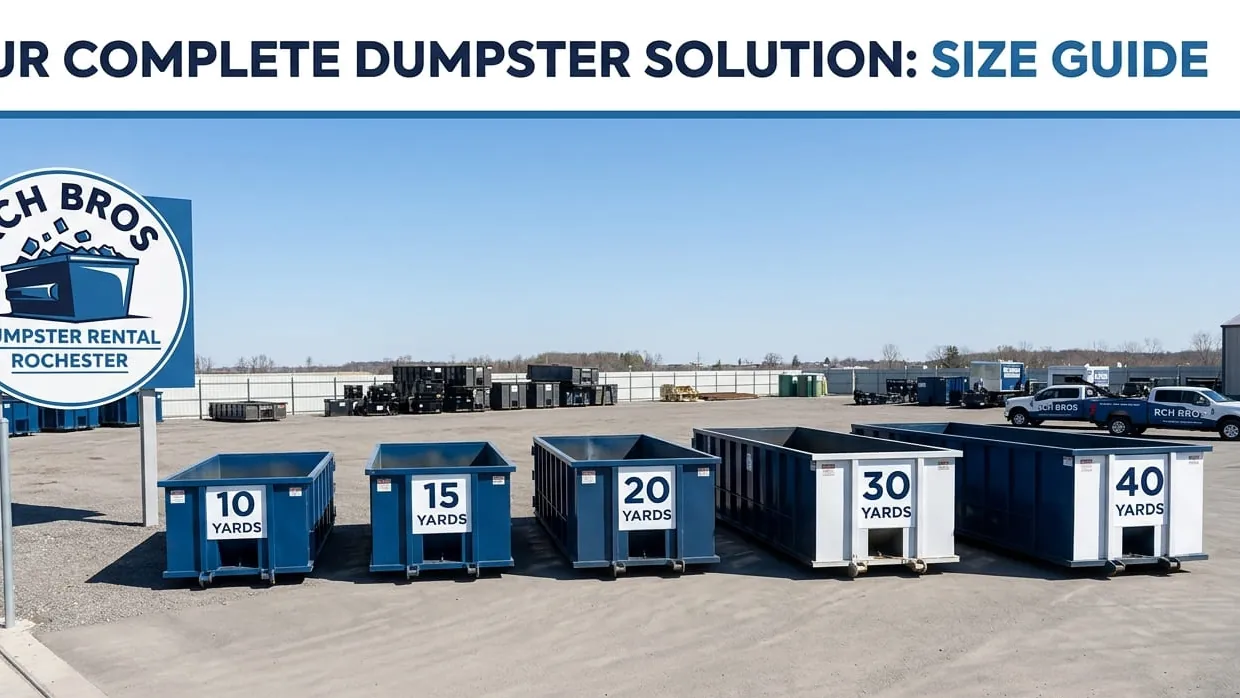
A 40 yard roll-off is about twenty-two feet long, eight feet wide and roughly eight feet tall — twelve to sixteen pickup loads. All of the extra capacity over a 30 is in the height of the walls, which makes it the most misused container in the business. Used for what it is designed for — light, bulky, high-volume material — it is the cheapest way to move debris there is. Used for anything dense, it is a container that cannot legally leave your site.
- Capacity40 cubic yards
- Footprint22 ft x 8 ft x 8 ft
- Weight allowance5 – 6 tons
- Holds about~12 – 16 pickup truck loads
Why people choose the 40 yard
The 40 is a volume container and the discipline that goes with it is absolute. Eight-foot walls mean you cannot see the load from the ground, and by the time a heavy material has made the container too heavy to lift, there is nothing on the outside to tell you. So the list of what belongs in it is short and specific: partitions, ceiling grid, systems furniture, office chairs, shop fittings, shelving, cabinetry, doors, framing, siding, insulation, carpet, packaging and household furniture. The list of what does not is equally short: concrete, brick, block, stone, tile in a mortar bed, plaster and lath, soil, turf, foundation spoil, wet basement contents and anything that has been standing open in the rain. If your job produces both, run a 40 for the bulk and a 10 for the dense material. That is not us selling you a second container; it is the arrangement that keeps the first one legal. We would rather have that conversation on the phone than send a driver to a container nobody can lift.
Whole-house cleanouts are the residential case. A pre-1940 Rochester house with a full basement, a floored attic and forty years of one family in it can genuinely fill a 40, particularly on an estate job where furniture is coming out along with the stored contents. The condition is that the load stays light. Household contents are light: furniture, clothing, bedding, boxed paper, carpet, curtains, toys, garden furniture. What turns an estate cleanout heavy is water, and basements here take water — a failed sump, a burst line, or meltwater backing down an interior wall behind an ice dam. Saturated cardboard and swollen furniture weigh two to three times what they look like. If the basement is wet, that material goes in a smaller container loaded flat and the 40 takes what is dry. Say so on the phone and we will bring the right combination rather than discovering it at collection. Wet material also keeps gaining weight while it stands, so a soaked load wants collecting promptly rather than left open through a wet week.
The commercial case is a gut job, and this is where the 40 is genuinely the cheapest tool available. An office strip-out produces partitions, ceiling grid, carpet tile, cabling, systems furniture and packaging in enormous volume and almost no weight. A retail refit produces shelving, display units, shopfront timber and cardboard. Both would need three or four smaller containers and three or four collections to do the same work. City Code § 20-15F is explicit that contractors performing work must arrange the proper and legal collection and disposal of waste generated during the construction process, and that such waste shall not be collected by the City, so a commercial gut job in Rochester is a private hauling job from the first day. Keep the cardboard flattened and separated, pull scrap metal out for value, take electronics out of the load entirely under ECL Article 27, Title 26, and commingle the rest. Mill Seat Landfill, the county-owned facility in the Town of Riga, is commercial accounts only, so this was always going to be a hauler arrangement rather than a run of pickup loads.
Then there is redevelopment, which in this city has a name. Rochester spent three years filling in a sunken expressway on the east side of downtown, and it is about to do it again on the north. Inner Loop North was approved for federal funding in January 2025 with a $100 million grant through the Reconnecting Communities Pilot Program, removing the segment between I-490 and North Union Street and converting it to a surface boulevard. Construction is expected to begin in 2027 and the project opens up roughly 22 acres of redevelopable land, on top of the six acres Inner Loop East created. Every acre of that is demolition, excavation and construction debris, and the buildings that go up on it will generate their own. Work at that scale runs on 40 yard containers for the light material and small containers for the heavy, on a swap schedule rather than a booking. If you are working on it, call the yard and we will set the account up properly.
Good fit for
- Whole-house and estate cleanouts, dry contents
- Commercial and office gut jobs
- Partitions, ceiling grid and systems furniture
- Retail refits and shop fittings
- Cabinetry, doors, trim and framing
- Siding, insulation and housewrap
- Carpet, underlay and curtains in bulk
- Redevelopment and site construction debris
Not the right size for
- Concrete, brick, block or stone of any quantity
- Soil, turf, fill and foundation spoil
- Plaster and lath from a pre-1940 house
- Tile set in a mortar bed
- Wet or water-damaged basement contents
- Roof tear-offs, which are a weight load
Will it fit?
A 40 is about the same twenty-two feet long as a 20 or a 30, so it fits the same ground: roughly 60 feet of straight approach, about ten and a half feet of working width and 20 feet or more of overhead for the hoist. Where it differs is the height of the container itself. At around eight feet the walls are above head height, so all loading goes through the swing door and the container has to be set with the door facing the work — tell us which side at booking, because turning a 40 around on a tight site is not a five-minute job. A walk-board or a ramp is worth setting up on anything hand-loaded. Overhead clearance matters more than usual too, because the hoist has to stand a taller container up: on Rochester’s older residential streets the mature canopy and the electrical service drop beneath it will rule out a 40 on plenty of driveways where a 15 sets easily. Plywood goes under every wheel and under the rails. Placement holds five feet clear of combustible walls, openings and combustible roof eave lines under the Fire Code of New York State at 19 NYCRR Part 1225, with the capacity threshold having tightened in the 2025 code cycle — check locally. A right-of-way placement needs a written permit from the City Engineer under City Code § 104-24, barricaded and lit at night under § 104-24(C), and a container this size in a Rochester street in December wants proper reflective marking.
Before delivery, move cars and bins, mark irrigation heads and septic lids, and tell us about new concrete, soft ground, a steep grade or low power lines. Our delivery and driveway protection guide covers all of it.
Compare all four sizes
| Size | Footprint | Weight allowance | Holds about | Best for |
|---|---|---|---|---|
| 10 Yard Dumpster | 12 ft x 8 ft x 3.5 ft | 2 – 3 tons | ~3 pickup truck loads | Concrete, brick, plaster and lath and rubble foundation spoil — weight fills it long before volume does. |
| 15 Yard Dumpster | 16 ft x 8 ft x 4 ft | 2 – 3 tons | ~4 – 5 pickup truck loads | A single room, a small tear-off, or one unit of a two-family turnover. |
| 20 Yard Dumpster | 22 ft x 8 ft x 4.5 ft | 3 – 4 tons | ~6 – 8 pickup truck loads | A full basement and attic clear-out — the Rochester default — or a multi-room remodel. |
| 30 Yard Dumpster | 22 ft x 8 ft x 6 ft | 4 – 5 tons | ~9 – 12 pickup truck loads | A whole two-family turnover with basement and attic, or a large remodel. |
| 40 Yard Dumpster | 22 ft x 8 ft x 8 ft | 5 – 6 tons | ~12 – 16 pickup truck loads | Whole-house cleanouts, commercial gut jobs and redevelopment debris. |
Still not sure? Describe what you are throwing away and we will size it on the phone in two minutes. Getting it wrong costs us more than it costs you, so we have every reason to get it right. Call (585) 514-5622.
Book a 40 yard
Flat rate including delivery, pickup, rental period and disposal. Same-day where we can.
(585) 514-5622Other sizes
Popular services
All sizes
Compare our four roll-off containers
10 Yard Dumpster
Concrete, brick, plaster and lath and rubble foundation spoil — weight fills it long before volume does.
View this size → 15yd³15 Yard Dumpster
A single room, a small tear-off, or one unit of a two-family turnover.
View this size → 20yd³20 Yard Dumpster
A full basement and attic clear-out — the Rochester default — or a multi-room remodel.
View this size → 30yd³30 Yard Dumpster
A whole two-family turnover with basement and attic, or a large remodel.
View this size → 40yd³40 Yard Dumpster
Whole-house cleanouts, commercial gut jobs and redevelopment debris.
View this size →40 Yard Dumpster FAQs
Why can I not put concrete in a 40?
Because you would never see it coming. At around eight feet the walls are above head height, so there is nothing on the outside of the container to tell you how heavy the load has become. Concrete, brick, stone, tile in a mortar bed and plaster with lath attached are all several times denser than the material a 40 is designed for, and a modest-looking quantity of any of them will take the container past a legal payload while the sides are nowhere near full. At that point it cannot be lifted onto the truck or driven on a road. Heavy material goes in a 10 or a 15, loaded flat. That is not a preference, it is what makes the load lawful.
Will a 40 fit on a residential driveway?
Sometimes, and less often than a 15 or a 20. The length is much the same — about twenty-two feet — so the ground is usually not the problem. The problem is overhead. The hoist has to stand a taller container up as it comes off the rails, and in Rochester’s older neighborhoods the street canopy is mature with the electrical service drop running beneath it from the pole to the house. That combination rules out a 40 on plenty of city driveways. Send a photograph from the curb looking up the drive and we will tell you before anybody wastes a morning.
Is a 40 right for a whole-house cleanout?
It can be, and for an estate job in a pre-1940 house with a full basement and a floored attic it often is. The condition is that the load stays light: furniture, clothing, boxed paper, carpet, curtains and general household contents. What breaks it is water and demolition. A basement that has taken water produces saturated material weighing two to three times what it looks like, and a cleanout that turns into a strip-out produces plaster, which is heavy. If either applies, run a smaller container alongside for the dense material and keep the 40 for what is dry and bulky.
What about a commercial strip-out?
This is exactly what the 40 is for. Partitions, ceiling grid, carpet tile, cabling, systems furniture, shelving and packaging are the highest-volume, lowest-density material in the business, and doing that job in smaller containers means paying for three or four extra collections. Keep cardboard flattened and separated, pull scrap metal out for value, and take electronics out of the load entirely — New York banned covered electronics from landfills, waste-to-energy, the trash and curbside on 1 January 2015 under ECL Article 27, Title 26. Asbestos never goes in, and on any pre-1974 building the survey question under 12 NYCRR Part 56 comes first.
Do you supply these for redevelopment work?
Yes, and there is going to be a good deal of it here. Inner Loop North was approved for a $100 million federal grant in January 2025 through the Reconnecting Communities Pilot Program, converting the segment between I-490 and North Union Street to a surface boulevard, with construction expected to begin in 2027 and roughly 22 acres of land opened up. That follows the six acres created by the Inner Loop East removal. Work on that scale runs on swap schedules rather than individual bookings, with 40 yard containers for the light material and small containers for the masonry. Call the yard and we will set up a site account.
Services
What people put in a 40 yard
Residential Dumpster Rental
Driveway placement for the full-basement, attic and porch cleanouts a pre-1940 house produces.
Learn more →Commercial Dumpster Rental
Containers for businesses and contractors — City Code §20-15F puts construction waste on you, not the City.
Learn more →Construction Dumpster Rental
Mixed C&D in one roll-off, with next-day swap-outs across Monroe County.
Learn more →Roofing Dumpster Rental
Weight-rated cans sized by squares and layers, set five feet off the eave line.
Learn more →Roll-Off Dumpster Rental
10, 15, 20, 30 and 40 yard roll-offs across Rochester and Monroe County.
Learn more →Same-Day Dumpster Rental
Call before the cut-off and we can usually get a container to you this afternoon.
Learn more →Talk to a real person
Need a 40 yard in Rochester?
Tell us what you are clearing out and we will tell you the right size and the flat price to put it in your driveway. No forms, no waiting on an email — just call and we will sort it out in a couple of minutes.
Serving Rochester, Monroe County and Greater Rochester · Mon–Fri 6:30am–5pm, Sat 7am–1pm