
The whole building
30 Yard Dumpster Rental in Rochester, NY
The size for a whole two-family turned over top to bottom, basement and attic included, or a large remodel running alongside a cleanout. It is also the standing container on most Rochester job sites, because mixed construction debris is bulky rather than dense. What it is not is a container for masonry: at this height you can put four tons in it and still see the sides.
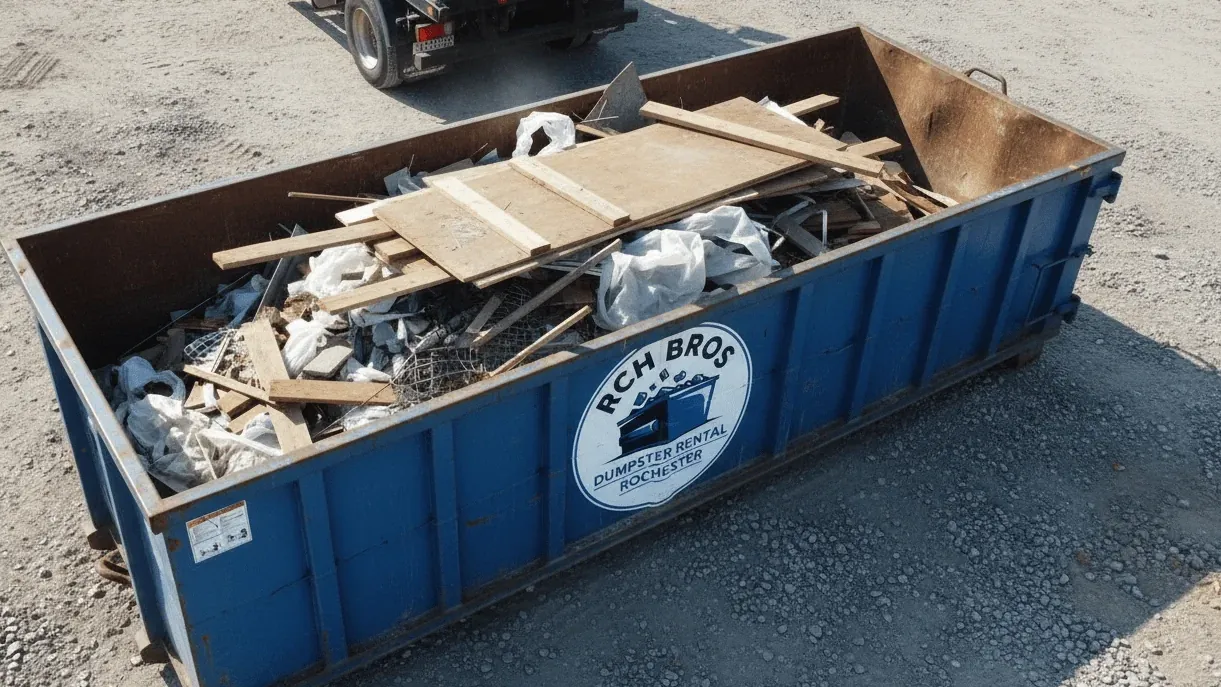
A 30 yard roll-off is about twenty-two feet long, eight feet wide and roughly six feet tall — nine to twelve pickup loads. The extra capacity over a 20 comes from height rather than length, which is the single most useful thing to know about it. The footprint is much the same, so it fits where a 20 fits, but the taller walls mean material goes in over a six-foot side and a heavy load can hide from you until the truck cannot lift it.
- Capacity30 cubic yards
- Footprint22 ft x 8 ft x 6 ft
- Weight allowance4 – 5 tons
- Holds about~9 – 12 pickup truck loads
Why people choose the 30 yard
The 30 is the container for a whole building rather than a whole room. In Rochester that most often means a two-family up-and-down double emptied completely: both units, the basement and the attic, in one job rather than one flat at a time. This is a renter-majority city — only about 38 per cent of housing units inside the city line are owner-occupied — so whole-building turnovers happen here at a rate that surprises people from newer markets. A building coming back on the market after a long tenancy produces carpet, cabinets, vanities, blinds, mattresses, abandoned furniture and two floors of stored material, and it produces it all at once. The other classic 30 yard job is a large remodel running alongside a cleanout, where cabinetry, flooring, trim and general debris are coming out at the same time as the household contents. Both are bulky, mixed loads that build volume fast and weight slowly, which is exactly what this container is for.
It is also the standing container on most Rochester job sites, and that is a function of what construction debris here is made of. Framing offcuts, sheathing, engineered lumber banding, housewrap, insulation, doors, trim, cabinetry, siding and packaging are all bulky and light. A 30 absorbs a week of that without a swap, which keeps a crew working rather than waiting. City Code § 20-15F puts the obligation squarely on the contractor: contractors performing work must make arrangements for the proper and legal collection and disposal of waste generated during the construction process, and such waste shall not be collected by the City. There is no municipal route for it and the county landfill at Mill Seat is commercial accounts only, no residential customers, Monday to Friday from 7:00 am to 3:30 pm. A site container swapped on schedule is the practical answer, and a 30 is the size most of our contractor accounts settle on. On a site with no lay-down space, which describes most infill work on a narrow Rochester lot, it is also the only place the debris can go.
The thing to be careful about at this size is weight, and the reason is the height rather than the volume. A 30 has roughly six-foot walls. You can put four tons of the wrong material into it and still be looking at bare sides, and by the time it is obvious that the load is heavy, the container is already too heavy to lift. Plaster and lath is the usual culprit in this city, because more than half the housing here predates 1940 and pre-war walls were plastered over wood lath rather than boarded. Tile in a mortar bed behaves the same way. So does anything that has been rained or snowed on. The rule for a 30 is that dense material goes in a separate 10 or 15 loaded flat, and the 30 takes the bulk. Two containers loaded by material are consistently cheaper than one container that has reached payload half full and cannot lawfully move off your property.
Access is easier than the capacity suggests, because a 30 is roughly the same length as a 20. The extra volume is in the walls, so if a 20 fits your driveway a 30 almost certainly will too. What changes is loading. At six feet, you are no longer lifting material in over the rim, so the swing door matters much more and you want the container set with the door facing the work rather than the road. Tell us which side at booking. It also means a walk-board or a ramp becomes worth setting up on a job with any volume of hand-loaded material, and it means nothing should be thrown in from a height onto a hard floor. Overhead clearance is unchanged: we want 20 feet or more for the hoist, and in Rochester’s older neighborhoods the constraint is the street canopy with the electrical service drop running underneath it. Look up from the curb before you book, because that wire rules out more sets in this city than any driveway ever has.
Good fit for
- A whole two-family turned over, basement and attic
- Large remodels and multi-room renovations
- The standing container on a job site
- Retail refits and small commercial strip-outs
- Whole-property estate clearances
- Garage or outbuilding demolition, structure only
- Large landscape and property clearance
- Mixed construction and demolition debris
Not the right size for
- Concrete, brick, block or stone rubble
- Rubble foundation spoil and excavated rock
- Plaster and lath as the bulk of the load
- Wet basement contents in quantity
- Soil, fill and lifted turf
- Any driveway that will not take twenty-two feet
Will it fit?
A 30 is roughly the same twenty-two feet long as a 20, so the ground requirement barely changes: about 60 feet of straight approach, roughly ten and a half feet of working width and 20 feet or more of overhead for the hoist. If a 20 will go on your driveway, a 30 almost certainly will. What changes is height and therefore loading. At around six feet the walls are too tall to lift material over comfortably, so the swing door does the work and the container wants setting with the door facing the job rather than the street — tell us which side when you book. Plywood goes under every wheel and under the rails, and we photograph the ground on arrival, which matters more with a heavier container and matters most in March and April when the silt loams under this county are saturated and a thawing asphalt drive is at its softest. Placement holds five feet clear of combustible walls, openings and combustible roof eave lines under the Fire Code of New York State at 19 NYCRR Part 1225; the capacity threshold tightened in the 2025 code cycle, so check the current number with your local code enforcement officer. On a commercial site the usual obstruction is a canopy, a fire escape or a low bay door rather than a tree. If the container has to sit in the right-of-way, that is a written permit from the City Engineer under City Code § 104-24, barricaded and lit after dark under § 104-24(C).
Before delivery, move cars and bins, mark irrigation heads and septic lids, and tell us about new concrete, soft ground, a steep grade or low power lines. Our delivery and driveway protection guide covers all of it.
Compare all four sizes
| Size | Footprint | Weight allowance | Holds about | Best for |
|---|---|---|---|---|
| 10 Yard Dumpster | 12 ft x 8 ft x 3.5 ft | 2 – 3 tons | ~3 pickup truck loads | Concrete, brick, plaster and lath and rubble foundation spoil — weight fills it long before volume does. |
| 15 Yard Dumpster | 16 ft x 8 ft x 4 ft | 2 – 3 tons | ~4 – 5 pickup truck loads | A single room, a small tear-off, or one unit of a two-family turnover. |
| 20 Yard Dumpster | 22 ft x 8 ft x 4.5 ft | 3 – 4 tons | ~6 – 8 pickup truck loads | A full basement and attic clear-out — the Rochester default — or a multi-room remodel. |
| 30 Yard Dumpster | 22 ft x 8 ft x 6 ft | 4 – 5 tons | ~9 – 12 pickup truck loads | A whole two-family turnover with basement and attic, or a large remodel. |
| 40 Yard Dumpster | 22 ft x 8 ft x 8 ft | 5 – 6 tons | ~12 – 16 pickup truck loads | Whole-house cleanouts, commercial gut jobs and redevelopment debris. |
Still not sure? Describe what you are throwing away and we will size it on the phone in two minutes. Getting it wrong costs us more than it costs you, so we have every reason to get it right. Call (585) 514-5622.
Book a 30 yard
Flat rate including delivery, pickup, rental period and disposal. Same-day where we can.
(585) 514-5622Other sizes
Popular services
All sizes
Compare our four roll-off containers
10 Yard Dumpster
Concrete, brick, plaster and lath and rubble foundation spoil — weight fills it long before volume does.
View this size → 15yd³15 Yard Dumpster
A single room, a small tear-off, or one unit of a two-family turnover.
View this size → 20yd³20 Yard Dumpster
A full basement and attic clear-out — the Rochester default — or a multi-room remodel.
View this size → 30yd³30 Yard Dumpster
A whole two-family turnover with basement and attic, or a large remodel.
View this size → 40yd³40 Yard Dumpster
Whole-house cleanouts, commercial gut jobs and redevelopment debris.
View this size →30 Yard Dumpster FAQs
Is a 30 too big for a house?
For a single-family house being cleared out, usually yes, and a 20 is the better answer. Where a 30 is right is when the job is a whole building rather than a whole house: both units of a two-family emptied together with the basement and attic, or a large remodel running alongside a cleanout so that cabinetry, flooring and trim are coming out at the same time as the household contents. The trap is that the extra capacity is in the height, not the length, so it is easy to keep filling a 30 past the point where it can be lifted. If you are not sure, describe the job on the phone.
Can I put plaster or masonry in it?
Not as the bulk of the load. This is the size where weight discipline matters most, because six-foot walls hide a heavy load. You can put four tons of plaster, tile or rubble into a 30 and still be looking at bare sides, and at that point the container cannot lawfully be lifted onto the truck. In a city where more than half the houses predate 1940 and were plastered over wood lath, that is a live risk on almost every gut job. Run a 10 or a 15 alongside it for the dense material, loaded flat, and keep the 30 for the bulk.
Do I need a bigger driveway than for a 20?
Not really. A 30 is roughly the same length as a 20 — about twenty-two feet — because the extra volume comes from the height of the walls. So the ground requirement is the same: about 60 feet of straight approach, roughly ten and a half feet of width and 20 feet or more of overhead for the hoist. What does change is loading. At six feet you are not lifting material over the side, so think about where the swing door needs to face and tell us at booking. On a hand-loaded job it is worth setting up a walk-board rather than carrying everything to the door end.
Is this the right container for a job site?
It is the one most of our contractor accounts run. Mixed construction debris — framing, sheathing, insulation, doors, trim, cabinetry, siding, packaging — is bulky and light, and a 30 takes about a week of it without a swap. That matters, because City Code § 20-15F makes disposal the contractor’s responsibility outright and there is no municipal route for construction waste. Keep the masonry out in a separate container, keep asbestos out entirely, and pull the mercury thermostat off the wall on any demolition — NYSDEC names contractors demolishing buildings as required to bring them to a collection program.
How long can I keep it?
As long as the job needs. On a job site we usually run a standing swap arrangement instead, so you are not calling every time the container fills. On a residential whole-building turnover a fortnight is common. Ring the yard on (585) 514-5622 when you want it collected. Two things to watch at this size. Nothing above the rim, because a load that cannot be tarped cannot legally travel and a 30 makes it easy to heap. And keep it covered: in this county rain and snow both turn straight into payload, and January alone brings about 27 inches of snow across roughly eighteen snow days.
Services
What people put in a 30 yard
Residential Dumpster Rental
Driveway placement for the full-basement, attic and porch cleanouts a pre-1940 house produces.
Learn more →Commercial Dumpster Rental
Containers for businesses and contractors — City Code §20-15F puts construction waste on you, not the City.
Learn more →Construction Dumpster Rental
Mixed C&D in one roll-off, with next-day swap-outs across Monroe County.
Learn more →Roofing Dumpster Rental
Weight-rated cans sized by squares and layers, set five feet off the eave line.
Learn more →Roll-Off Dumpster Rental
10, 15, 20, 30 and 40 yard roll-offs across Rochester and Monroe County.
Learn more →Same-Day Dumpster Rental
Call before the cut-off and we can usually get a container to you this afternoon.
Learn more →Talk to a real person
Need a 30 yard in Rochester?
Tell us what you are clearing out and we will tell you the right size and the flat price to put it in your driveway. No forms, no waiting on an email — just call and we will sort it out in a couple of minutes.
Serving Rochester, Monroe County and Greater Rochester · Mon–Fri 6:30am–5pm, Sat 7am–1pm